
If you have ever tried to write a melody that sounds emotional, cool, and slightly dark, but not too sad, you may have felt stuck without knowing why. Sometimes a regular major or minor scale just does not give you the color you are looking for.
That is where many musicians get frustrated. You want your chords, riffs, or solos to sound more interesting, but the theory behind modes can feel confusing at first. Terms like “Dorian mode” often sound advanced, even though the idea behind them is much simpler than it seems.
The truth is, Dorian mode is one of the most useful ways to give your music a richer mood without making it feel overly complex. It can help you create melodies that feel smooth, soulful, jazzy, or mysterious, while still staying easy to use once you understand the pattern.
Go and play “So What” by Miles Davis. ▶️
It’s One of the clearest examples. It is a modal jazz classic built around D-Dorian for most of the tunes.
Let’s talk more about Dorian mode.
In this blog, we will break down what Dorian mode really is, how it sounds, how it works, and how you can start using it in real music without getting overwhelmed.
What Is Dorian Mode?
Dorian mode is a minor-sounding scale that feels a little brighter and smoother than a regular natural minor scale. A simple way to think about it is this: it is like a minor scale with one important note changed, and that one change gives it a more open, soulful, and slightly hopeful color.
The Dorian mode with the interval pattern 1, 2, b3, 4, 5, 6, b7, and PianoScales also describes it as the second of the seven modes with that same pattern.
One reason Dorian mode matters so much is that it gives you a mood that sits between major and minor. It still sounds clearly minor because of the flat third, but the natural sixth keeps it from sounding as dark as a normal minor scale. That is why many musicians use it for jazz, funk, rock, and modal improvisation. Color note in D Dorian by pointing to B natural as the sound that brings out its distinctive character.
How Dorian Mode Is Built
Dorian mode is built with the formula 1, 2, b3, 4, 5, 6, b7.
That means it has a minor third and minor seventh, which give it its minor feeling, but it keeps a major sixth, which changes the emotional color.
There is also an easy way to find it. Dorian is the second mode of the major scale.
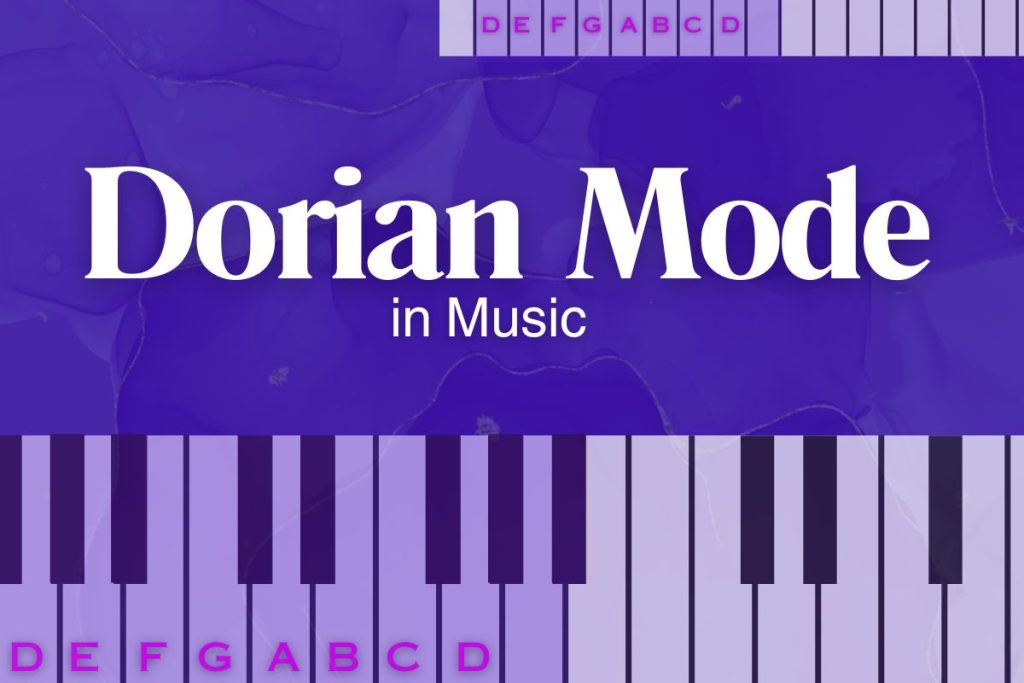
For example, if you take the notes of C major — C, D, E, F, G, A, B — and start from D instead of C, you get D Dorian: D, E, F, G, A, B, C. PianoScales explains this directly by noting that D Dorian includes the same notes as C major but starts on D.
So you can understand Dorian in two simple ways: as its own formula, or as a major scale starting from the second note. Both approaches lead you to the same sound. Thinking of it through the major scale can make it easier to learn and use in real playing.
Dorian Mode vs Natural Minor
Dorian mode and natural minor sound similar at first because both have a minor quality. They share most of the same notes, which is why many beginners confuse them.
The real difference is just one note:
| Dorian has a natural 6 | While, natural minor has a flat 6. |
Dorian formula shows the natural 6 clearly, and Melodics emphasizes that raised sixth as the note that makes the mode stand out.
That small difference changes the mood more than you might expect. Natural minor often sounds darker, sadder, and more closed. Dorian still sounds minor, but it feels more fluid, relaxed, and slightly brighter. It gives you a mood that is moody without becoming too heavy.
A simple example helps.
| D natural minor uses B-flat | but D Dorian uses B natural. |
That one note is enough to make Dorian feel more open and colorful. If you want a minor sound that still has some lift in it, Dorian is often the better choice.
How Dorian Mode Sounds
Dorian mode sounds moody, cool, soulful, and slightly bright at the same time. It still has the emotional pull of a minor scale, but it does not feel as dark or final as natural minor. That is why so many players describe it as a mode that feels minor, yet somehow more open and expressive.
Its special sound comes from the major sixth.
In D Dorian, the B natural is the note that brings out the mode’s distinctive character. If you do not highlight that note, the scale can just sound like ordinary minor. If you do highlight it, the Dorian flavor becomes much easier to hear.
This is also why Dorian mode works so well over minor seventh chords. PianoScales notes that the Dorian mode is often played over minor seventh chords, which makes sense because that brighter sixth blends well with a smoother minor harmony.
In practical terms, Dorian is a great choice when you want your music to feel emotional without becoming too sad, or jazzy without becoming too complex. It gives melodies a softer kind of tension and makes minor harmony feel more alive.
Two Simple Ways to Understand Dorian Mode
Dorian mode becomes much easier once you stop treating it like a scary theory term and start seeing it through two simple ideas. The first way is to think of it as a minor scale with a brighter sixth note. That is the quickest shortcut for most beginners. It still sounds minor because of the flat third, but that natural sixth gives it a more open and soulful color.
If a regular minor scale feels darker and heavier, Dorian feels a little lighter without becoming happy like a major scale.
The second way is to think of Dorian as the second mode of a major scale. For example, if you play the notes of C major but start from D and end on D, you get D Dorian. This way is useful because it helps you find the notes quickly.
So, one method helps you hear the mood. The other helps you build the scale. Together, they make Dorian much easier to understand and remember.
How to Find Dorian Mode in Any Key
A simple way to find Dorian mode is to start with a major scale and begin from its second note.
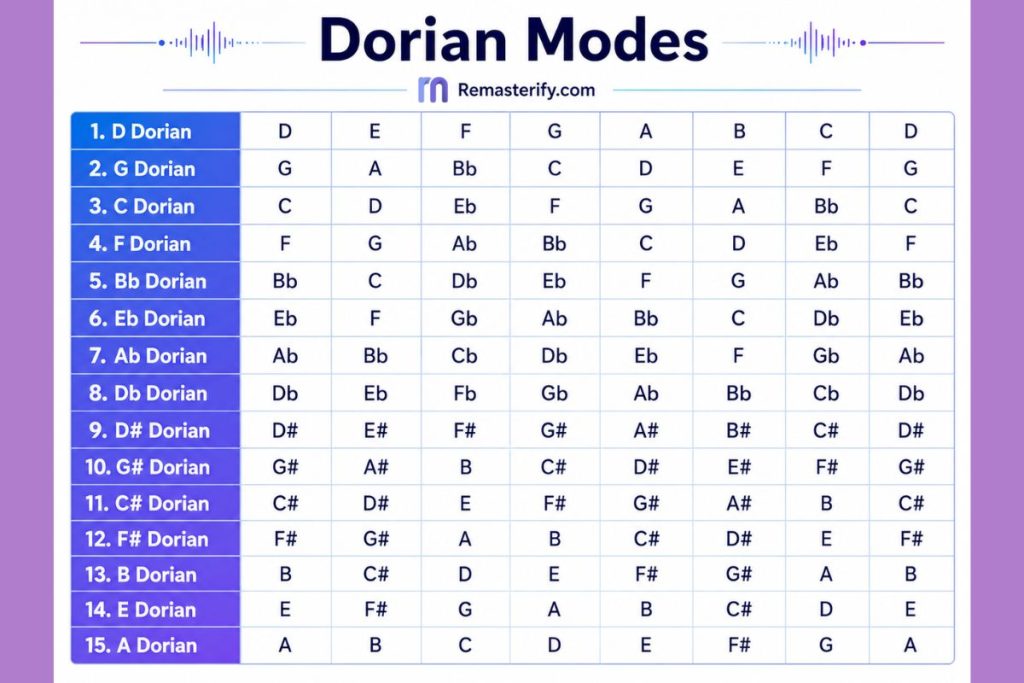
If you want D Dorian, think of C major. If you want E Dorian, think of D major. If you want A Dorian, think of G major. In each case, the Dorian scale uses the same notes as the major scale just before it on the keyboard or in theory terms.
You can also find it by using the formula: 1, 2, b3, 4, 5, 6, b7. This method is helpful when you already know your intervals. For example, D Dorian is D, E, F, G, A, B, C, D. It looks minor, but the B natural is what gives it that distinctive Dorian feel.
If you are a beginner, use the major-scale method first. It is faster and easier to apply in real music. Once you get more comfortable, the interval formula will start making more sense too.
How Musicians Use Dorian Mode in Real Music
Musicians use Dorian mode when they want a sound that feels minor, but not too dark. It is often used in jazz, funk, rock, folk, and modal improvisation because it creates a mood that feels smooth, cool, and expressive. If natural minor can feel sad or heavy, Dorian often feels more relaxed and alive.
- One common use of Dorian mode is in melody writing. A melody in Dorian can sound emotional and thoughtful without sounding overly dramatic. That makes it useful for songs that need depth but also movement.
- It also works well in soloing, especially over minor seventh chords, because the natural sixth gives players a note that adds color without sounding too tense.
- Dorian mode is also useful in vamps and grooves. If a song stays on one minor chord for a while, using Dorian can stop the harmony from sounding flat or too predictable. That extra color note helps keep the mood interesting. In practical music-making, Dorian is not just a theory idea. It is a way to create a specific emotional shape inside a song.
Common Mistakes Beginners Make With Dorian Mode
1. One of the biggest mistakes beginners make is treating Dorian exactly like natural minor. The two are close, but they do not sound the same. If you ignore the natural sixth, your Dorian line may just sound like ordinary minor, and the whole point of using the mode gets lost.
2. Another mistake is memorizing the notes without listening to the mood. Dorian is not useful just because you know the formula. It becomes useful when you can actually hear what makes it different. If you do not emphasize the color note in your melody or phrase, the mode can feel invisible.
Some beginners also try to learn modes only as scale shapes. That may help with finger memory, but it does not always help with musical understanding. Dorian works best when you connect the shape, the interval pattern, and the emotional sound all together.
A final mistake is using too many notes without intention. Dorian sounds strongest when the phrasing is clear and the color note is used with purpose. The goal is not to prove you know a mode. The goal is to make the music feel more expressive.
What Modern Producers Can Learn From Dorian Mode
Modern producers can learn something important from Dorian mode: a small change in note choice can completely change the emotional identity of a track. That is a powerful lesson.
Sometimes the difference between a flat melody and a memorable one is not more complexity. It is one note that shifts the mood in the right direction.
Dorian mode teaches producers to think more carefully about color. It shows that music can feel dark without becoming too heavy, and emotional without becoming predictable. This is especially useful in genres where mood matters as much as melody, such as ambient music, lo-fi, indie, cinematic production, neo-soul, and electronic music.
It also reminds producers that theory is not only academic.
It can be practical and creative. When you understand why Dorian sounds the way it does, you can write better toplines, stronger riffs, and more distinctive progressions.
Once that mood is built, the final production process matters too. A great modal idea still needs enough clarity, balance, and polish to feel complete in the final track.
That is where a tool like Remasterify fits naturally. Dorian mode helps shape the feeling of the music. Remasterify helps that feeling come through more clearly in the final master.

Get clean and enhanced sound within 30 seconds
It’s Remasterify, an audio remastering platform to make your final master sound more professional.