
So your track sounds boring?
Don’t say your tracks don’t make sense. Try syncopation this time and listen again to how it sounds.
Syncopation is a crucial element in writing rhythms to make your track groovy and interesting.
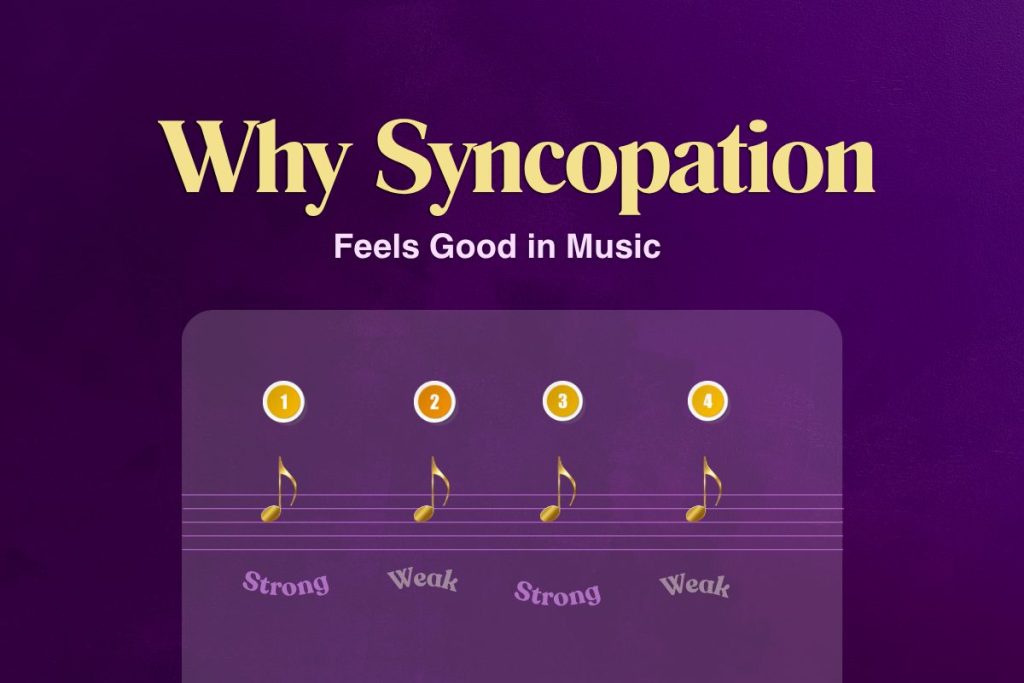
Have you ever heard a rhythm that instantly made you move, even if you did not know why? Sometimes the beat does not land where you expect, and that is exactly what makes the music feel more exciting, playful, and alive.
That feeling often comes from syncopation. It is one of the reasons some songs sound more groovy, catchy, and emotionally engaging than others. Even a small rhythmic shift can make a track feel less predictable and much more enjoyable to hear.
In this blog, we will break down why syncopation feels so good, how it works in real music, and what creators can learn from it when building more engaging tracks.
What Syncopation Means in Simple Words
Syncopation is when the rhythm places emphasis where you do not normally expect it. Instead of landing on the strongest beat, the music pushes attention toward a weaker beat, an off-beat, or the space between beats. That small shift is what makes the rhythm feel more playful and alive.
In simple words, syncopation is what happens when music surprises your ear in a good way. It breaks the steady pattern just enough to make the groove feel more interesting. The beat does not disappear, but it starts moving with more bounce and personality.
That is why syncopation is so common in styles like jazz, funk, pop, Latin music, hip-hop, and dance music. It gives a rhythm more motion without making it feel random.
Why Syncopation Feels So Good to the Ear
Syncopation feels good because it creates a balance between familiarity and surprise.
Your ear still senses the main beat, but the accents do not always fall where you expect them to. That little twist keeps the rhythm engaging.
If every note landed in the most obvious place, music could start feeling too straight or predictable. Syncopation adds a small amount of tension, and that tension makes the groove feel more satisfying when it resolves. It keeps the listener involved because the rhythm feels like it is moving forward instead of sitting still.
There is also a physical side to it. Syncopated rhythms often make people tap, nod, or move without thinking too much. The groove feels more human because it has a little push and pull in it. That is one reason syncopation shows up so often in music that feels catchy, danceable, or emotionally alive.
How Syncopation Creates Groove and Tension
Syncopation creates groove by shifting the energy of the rhythm. When accents fall on weaker beats or off-beats, the listener feels a subtle pull away from the obvious pattern. That makes the music feel less rigid and more fluid.
- It creates tension because the rhythm is not fully doing what you expect. The beat is still there, but the emphasis moves around it. That tension is usually not harsh or uncomfortable.
- It is the kind of tension that makes a track feel exciting. It keeps the ear waiting for what comes next.
Groove comes from that repeated feeling of movement. A syncopated bassline, chord stab, or drum pattern can make the music feel like it is leaning forward. Instead of sounding stiff, the track begins to bounce. That bounce is often what separates a rhythm that feels correct from one that feels unforgettable.
Where Syncopation Shows Up in Real Music
Syncopation shows up almost everywhere once you start listening for it. You can hear it in drums, where the snare, hi-hat, or kick lands in unexpected places. You can hear it in basslines that avoid the strongest beat and instead create a more elastic groove.
Some real examples where syncopation has been followed;
Billie Eilish – “bad guy”
The rhythm feels playful and slightly off-center in a way that makes the track more interesting. Syncopation helps give it that unusual bounce.
Michael Jackson – “Billie Jean”
The groove feels so strong because the rhythm does not just sit heavily on the obvious beats. The bass and drum interaction creates a tight, bouncing feel that makes the track instantly recognizable.
Bruno Mars – “Uptown Funk”
This track uses syncopation in the drums, guitar, brass hits, and vocal phrasing. That is a big reason the song feels so energetic and addictive.
It also appears in melodies and vocals.
A singer may stretch a phrase across the bar or land a strong word between beats instead of directly on them. That simple change can make the line feel more expressive and memorable.
Chords can be syncopated too.
In funk, pop, and dance music, short chord stabs often hit off the beat to create movement. In Latin and jazz styles, syncopation is often a core part of how the rhythm breathes. Once you recognize it, you start noticing that many of the most engaging songs rely on syncopation to keep the music from feeling flat.
How Producers Use Syncopation in Modern Tracks
Modern producers use syncopation to make tracks feel more dynamic and less mechanical.
A straight rhythm can work, but syncopation often adds the spark that makes the groove feel more alive. Even a small rhythmic shift in the drums or bass can change the whole energy of a track.
- In beat-driven music, producers often use syncopation in the kick pattern, snare placement, or hi-hat rhythm to create bounce.
- In melodic production, they may use it in vocal chops, chord stabs, or lead synth phrases so the track feels more engaging.
- It is also common in drops, transitions, and fills, where syncopation helps build anticipation.
The important thing is balance. Too little syncopation can make a track feel stiff. Too much can make it feel unstable. Good producers use it with intention. They place it where it helps the groove breathe, catches the ear, and gives the arrangement more movement.
What Modern Producers Can Learn From Syncopation
One of the biggest lessons syncopation teaches is that rhythm is not only about timing. It is also about emotion and feel.
Two tracks can use the same sounds, the same tempo, and the same chords, but the one with better rhythmic placement often feels far more alive.
Syncopation shows producers how small changes can create a big reaction. You do not always need more layers or louder sounds to make a track exciting. Sometimes a better rhythmic accent is enough. That is an important reminder in modern production, where the best ideas are often the simplest ones used in the right place.
It also teaches that groove needs support. A syncopated idea may sound great when written, but it still needs clarity, punch, and balance in the final track. If the mix is muddy or the master flattens the movement, the groove can lose its effect. That is where final polish matters.
A tool like Remasterify can help keep those rhythmic details clearer, tighter, and more balanced in the finished master.
Let your groove stay punchy and balanced.