
Before Avicii became Avicii, he was a teenager in Stockholm building tracks in his bedroom. One of the tools he reached for early was a piece of software called Mixed In Key. It did one thing well. It told him what key every song was in, and which keys would sound good together. He used it to pick samples that fit his beats. He used it to plan his sets. He used it to make every drop feel inevitable.
That software was built around something called the Camelot Wheel.
You probably know the feeling it’s meant to fix. You finish a few tracks for an EP. Each one sounds great on its own. But when you play them back-to-back, something is off. The flow breaks. The energy drops in the wrong places. You can’t quite name it.
It’s almost always the keys. They’re not talking to each other.
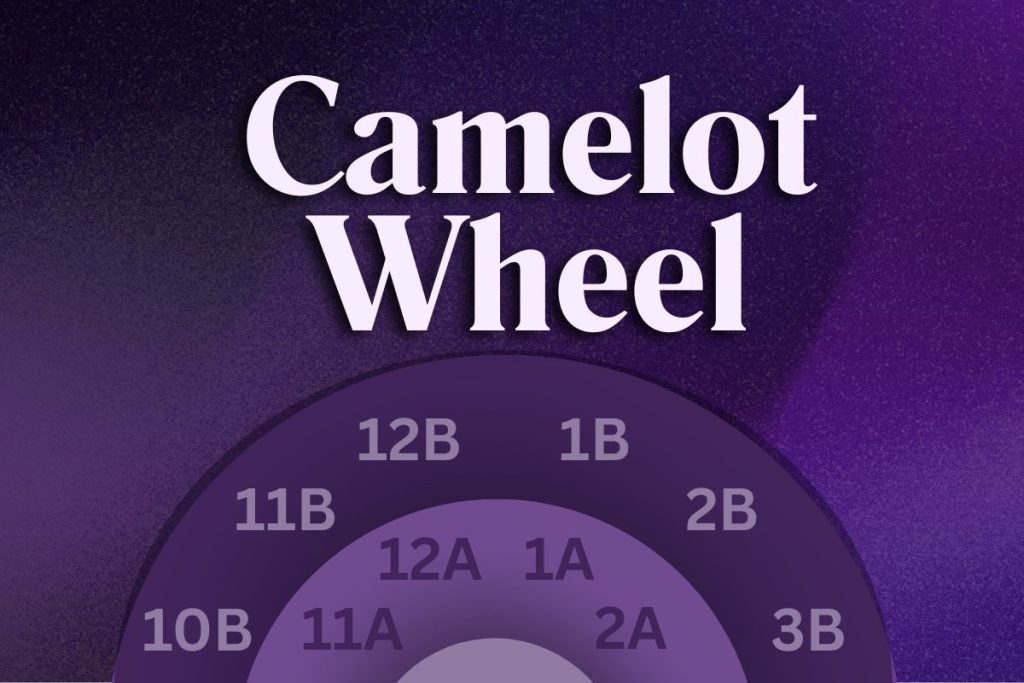
The Camelot Wheel solves that. It is a small diagram with a big payoff, and once you understand it, you stop guessing about key changes and start making them on purpose. In this guide, you will learn what the wheel actually is, how DJs use it to keep dancefloors moving, how producers use it to sequence albums that flow, and how to use it on your own tracks tonight.
By the end, you will not just understand the wheel. You will know exactly what to do with it.
What the Camelot Wheel Actually Is
Start with what it looks like. The Camelot Wheel is a circle, drawn like a clock face, with twelve positions numbered one through twelve. Every position has two halves, an A and a B. That gives you twenty-four spots in total, and every musical key fits into exactly one of them.
That is the whole system. A circle, twelve numbers, two letters.
Here is why it exists. Traditional music theory tells you that a song is in, say, F-sharp minor. Useful information, but only if you already know which keys sound good next to F-sharp minor. Most producers do not. Music theory takes years to learn well, and you do not have years when you are trying to finish an EP this month.
The Camelot Wheel skips the theory and gives you a map. F-sharp minor becomes 11A. Its compatible neighbors are 10A, 12A, and 11B. You do not need to know why those keys work together. You just need to know they do.
A DJ named Mark Davis built the system in the early 2000s and licensed it to a software company called Mixed In Key. The software detects the key of any audio file and labels it with its Camelot number. Within a few years, the wheel had spread from DJ booths into bedroom studios, and today most major key-detection tools, from Serato to Tunebat to Beatport, use Camelot notation alongside traditional keys.
You do not need to read music to use it. That is the point.
How the Wheel Works
Now that you know what it is, here is how to actually read it.

Picture a clock. Twelve numbers around the edge, just like the hours. Each number has an inner ring and an outer ring. The inner ring is A, which stands for minor keys. The outer ring is B, which stands for major keys. Every song you have ever heard sits somewhere on this clock.
The rule is simple. Three moves are safe.
You can stay on the same number, switching between A and B. That is moving from a minor key to its relative major, or the other way around. The mood shifts, but the notes stay friendly. Think of it as the same room with different lighting.
- Clokwise: You can step one number clockwise. The energy lifts. The track feels brighter, more open, slightly more urgent.
- Anticlockwise: You can step one number counterclockwise. The energy settles. The track feels deeper, calmer, more grounded.
That is the whole rulebook for a smooth transition. Same number, one step up, or one step down. Anything else and you are taking a risk. Sometimes that risk pays off. Most of the time, it sounds like a mistake.
The beauty of the wheel is that you do not have to remember any of this in the moment. You just look at the number on your current track and the number on the next one. If they are within one step, you are safe. If they are not, you already know you need a transition that earns the jump.
This is why DJs swear by it. And it is also why producers, once they discover it, start hearing their own albums differently.
How DJs Use the Camelot Wheel
DJs were the first group to take this system seriously, and they had a real problem to solve. A live set is a long, continuous piece of music. The crowd does not get a break between songs. If the keys clash during a transition, even people who do not know what a key is will feel it. The energy drops, the dance floor hesitates, and you lose the room.
The wheel fixed that. Before a set, a DJ would key their entire library, label every track with its Camelot number, and then build the setlist around safe moves. Track one might be 8A. Track two could be 8B, 7A, or 9A. From there the journey continues, each transition staying within one step of the last.
Watch a great DJ closely and you will see them doing more than picking songs. They are climbing the wheel. They start in one place, walk it deliberately, and bring the room with them. By the end of the night, they have moved through six or eight keys and the crowd never noticed, because every step felt inevitable.
That is what harmonic mixing actually is. Not magic. Just a map, read carefully.
How Producers Use the Camelot Wheel
Producers found a different use for it, and this is where things get interesting.
DJs use the wheel in real time, blending tracks they did not write. Producers use it earlier, while they are still making the music. The applications are quieter but just as important.
You use it to pick samples that fit. If your beat is in 5A and the vocal sample you love is in 11B, the clash will be obvious the moment you drop them together. Checking the keys first saves you an hour of trying to force them to coexist.
You use it to plan remixes. If you are working with stems from another producer, knowing their key tells you which directions you can push the remix without breaking the original.
You use it to sequence releases. This is the most overlooked one. An EP or album is a journey, and the order of the tracks shapes how that journey feels. Two great songs in clashing keys, played back to back, will sound like two great songs that do not belong on the same record.
The wheel does not write the music for you. It just keeps you from accidentally sabotaging your own work.
Using the Camelot Wheel to Sequence a Release
Here is the practical workflow, the one you can use tonight.
Start by finding the key of every track on your project. Most DAWs have a built-in key detector, and dedicated tools like Mixed In Key, Tunebat, and Serato will do it faster and more accurately. Each one will give you a Camelot number alongside the traditional key.
Write the numbers down. Six tracks gives you six Camelot positions, scattered around the wheel.
Now sequence them. Place the opening track where you want the listener to enter the album. From there, move to a track within one step on the wheel. Keep going. If two tracks share the same number, you can place them next to each other. If they are one step apart, you can place them next to each other. Anything further and you have a decision to make.
That decision is where the artistry comes in. Sometimes you want a big jump between tracks four and five, because the album is shifting moods. A jarring key change can feel intentional and powerful, the same way a key change in the final chorus of a song can. But it has to be a choice, not an accident.
The wheel does not tell you what to do. It tells you what you are doing.
The Other Half of Album Flow
Once your keys are in order, the album should feel better. But you will probably notice something else. Even with a perfect key sequence, the record might not flow yet.
The reason is that harmonic flow is only half of what makes an album feel whole.
The other half is sonic consistency. How loud each track is relative to the next. How the bass sits across the record. Whether the vocals have the same brightness on track three as they do on track six. A great key sequence cannot hide an album where every track was mastered differently, because the listener feels the jolt every time the volume jumps or the tone shifts.
This is the part that breaks most independent releases. Producers spend weeks on the songs, careful hours on the mixes, and then master each track on its own. The result sounds fine in isolation, but the moment you press play on the album, the inconsistencies stack up.
Remasterify solves this with reference track matching. You pick one track that has the sound you want, the loudness and the tone you are aiming for, and the platform matches every other track on the release to it. The keys carry the harmonic flow. The mastering carries the sonic flow. Together, they make the record feel like one piece of music instead of six uploads on the same artist page.
A Map for the Music You Are Making
The Camelot Wheel started as a DJ tool. It became a producer’s tool. And once you have used it on your own work, it stops being a diagram and starts being a habit, something you check almost without thinking.
A great release sounds intentional from the first second to the last. The Camelot Wheel handles the keys. Good mastering handles the rest. Together, they turn a collection of songs into a record that feels like it was always supposed to exist.
You already wrote the songs. The wheel and the master just help the world hear them the way you do.

The wheel handles the keys.
Remasterify handles the rest. Upload your tracks and hear them sound like one record.