
Shaping your sound the way you like most is no longer a big deal.
At present, you have all the cutting-edge tools to tune your music. From controlling sync to managing effects, you can do anything.
But if muddy sounds are still coming in your mixes, you must understand the fundamentals of electronic music creation. Gain staging is the first thing you can start with.

Delivering the sound that you created through your creative instinct directly to your listeners is much easier than you think.
Here’s a catch. Most new music creators often ignore gain staging or don’t fully understand its importance. As a result, the sounds they want to create do not come out exactly as intended. To address this huge issue, this blog provides a guide to help ambitious music producers create great music.
If you’re among those ambitious ones and show the world what good music is, you’re welcome here.
Should we start with the gain staging concept now?
In this Blog
- Why should you care about gain staging?
- Unstoppable benefits of gain staging
- 3 steps to execute better gain staging
- AI sound mastering
- Gain staging FAQs
- Gain staging glossary
Gain staging meaning
At the basics, gain staging is a process for controlling the audio signal levels as they flow through the mixing chain.
Maintaining a balanced signal level throughout your entire mix is the goal here. It’s the way to avoid distorting sound, noise, and clapping that may appear in your music. So, gain staging controls signal levels. As a result, you can achieve clean, clear audio with healthy headroom.
In electronic music, multiple layers of sound coexist. You know better if you’re in this field. Now imagine all the mixes going under a poor gain staging process. Maybe you’ll hear a chaotic mess, nothing else. Hence, you need to use proper gain staging to deliver your music with great sound.
Why should you care about gain staging?
When you produce electronic music, every sound in your project passes through a digital chain of instruments, plugins, effects, buses, and the master channel, which means each level decision affects the next one.
If your signals are clean, balanced, and controlled from the beginning, your mix has a much better chance of sounding polished by the end.
But when gain staging is ignored, problems start building quietly in the background until they become hard to fix later.
Here are the main problems you can encounter with;
- A signal that is too hot can create clipping and unwanted distortion, while levels that are pushed too far can reduce your headroom and leave your track feeling smaller and less dynamic than it should.
- Inconsistent gain can also make unwanted noise or digital artifacts more obvious, especially when you start boosting softer elements.
Over time, all of this can lead to a mix that feels crowded, unclear, and uneven, where the most important sounds either get buried or stick out too aggressively.
Unstoppable benefits of gain staging
Music production is never just about adding sounds on top of each other. It is about building a strong foundation so that every new layer works with the layers before it rather than fighting them. That is exactly why gain staging matters.
When you manage your levels properly throughout the production process, you protect your audio from unnecessary clipping, distortion, and noise, and you make the entire session easier to control.
Expect predictable sound: A well-gain-staged project gives your plugins more predictable input, helps your buses stay cleaner, and leaves your master channel with enough room to breathe.
Make music collaboration easy: It makes collaboration easier, because when you hand a mix to another engineer, balanced levels and proper headroom make the next stage of work far more efficient.
Retain audio quality intact: Gain staging helps you preserve audio quality, improve mix clarity, and make better technical decisions from the very beginning.
While the idea of gain staging can vary depending on whether you are working in digital production or live sound, the core principle stays the same. When your levels are managed properly, your music sounds cleaner, stronger, and more professional.
Make your audio sound clean & punchy in just 30 seconds.
3 steps to execute better gain staging
Gain staging is easy and not overly technical. All you need is a little patience and focus to do this. Here you’ll find the easiest steps to improve your staging and elevate your entire musical experience.
Step 1: Record your audio carefully
Good gain staging starts at the recording stage, and one of the biggest mistakes producers make is recording too hot.
In digital audio, you do not need to push your levels close to 0 dB, as people often did in the analogue era. In fact, leaving more space is usually the better choice.
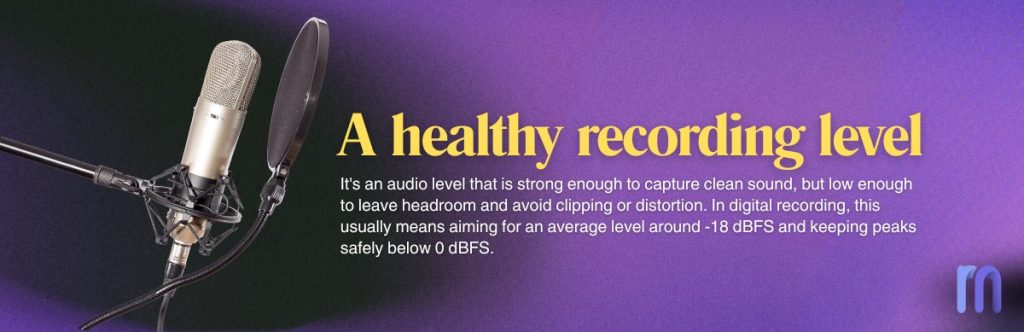
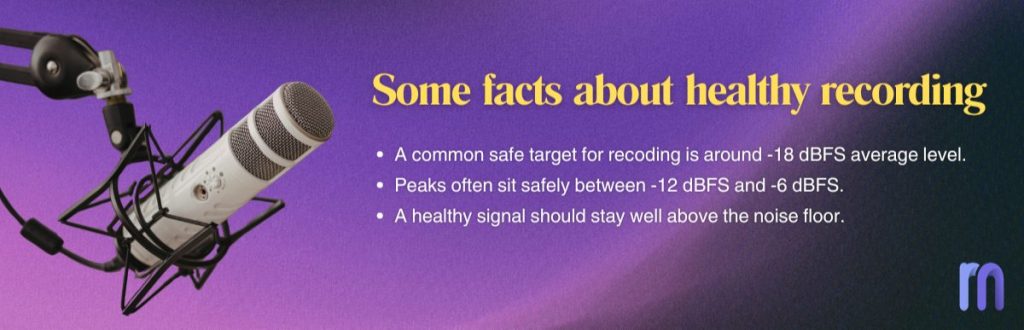
A healthy recording level around -18 dBFS gives you enough signal to stay above the noise floor, while leaving enough headroom to avoid distortion or clipping during recording. When you start with that kind of balance, you give your entire mix a cleaner, more stable foundation.
Step 2: Try to trim your signals sometimes
Even if you record at safe, controlled levels, your session can still overload once all the tracks start playing together. This is where trimming your signals becomes important.
Instead of simply pulling down the channel faders and hoping the problem goes away. It is often better to adjust each track’s clip gain first. Doing this helps you control the raw audio level before it reaches the mixer. That simply means your master fader is less likely to clip, and your session becomes easier to manage overall.
Plus, it also gives you a stronger starting point before you begin making creative balance decisions with your faders.
Step 3: Keep plugin levels consistent
You also need to pay close attention to the level at the input and output of your plugins. Because gain staging does not stop once the audio is recorded.
A signal can easily leave a plugin much louder than it entered. And if you do not notice that change, it can overload the next stage in the chain without you realizing it. That is why it helps to keep plugin input and output levels as consistent as possible, unless you are making a deliberate creative choice.
This becomes even more important with plugins that emulate analogue gear. It is because many of them have a sweet spot where they sound their best.
When you are intentional about how hard you drive those plugins, you get better tone, better control, and a much cleaner mix overall.
⭐You haven’t used professional tools to record your music, what to do now?
Well, do not worry at ALL.
Now, AI can do anything to improve your sound.
Many tools are now available on the market that do not require professionally recorded audio clips. You just need to upload your raw audio to fix everything. AI does work pretty well. It can remaster your audio to make it sound clean and consistent. Your listeners would enjoy it like nothing.
AI sound mastering can create a clean sound following the gain staging formula.
Having these issues?
- Your recorded sound is not at the optimal level.
- Your sounds have excessive loudness buildup.
- You’re not happy with the sound of your creation.
Fix all these in under a few seconds. ✔️
Remasterify is an AI-powered remastering platform made by musicians and developers.
Try how your music sounds after remastering it for free.
Common gain staging FAQs
A good gain staging level in digital music production is usually around -18 dBFS, especially when recording or feeding audio into plugins. This level gives you enough signal to stay clean and audible, while still leaving enough headroom to avoid clipping, distortion, or an overloaded mix later.
Gain staging in live sound means setting the signal level properly at every stage of the live audio chain so the sound stays clean, strong, and free from distortion. In a live setup, that usually starts with the microphone preamp and continues through the mixer, EQ, compressors, effects, buses, amplifiers, and speakers. If the gain is too low, the signal may sound weak or noisy. If it is too high, it can clip and sound harsh or distorted.
Gain staging is the process of carefully managing your signal level from one stage of the audio path to the next. In simple terms, it means making sure your audio isn’t entering any part of the chain too loud or too quiet.
The difference between volume and gain staging is that volume controls how loud something sounds, while gain staging controls how strong the signal is as it moves through the audio chain. Volume is what you adjust when you want a track, speaker, or final output to sound louder or quieter to the listener. Gain staging, on the other hand, is a technical process that happens behind the scenes to keep the signal balanced and healthy at every stage.
Gain staging glossary
1. Gain
Gain is the amount of signal level added at the input stage of an audio source. It controls how strong the sound is before it moves through the rest of the signal chain. Too much gain can cause distortion, while too little can make the signal weak or noisy.
2. Headroom
Headroom is the space between your normal signal level and the point where clipping begins. It gives your mix room to breathe and lets louder moments sound without distortion. Good gain staging always leaves enough headroom for safe and clean processing.
3. Clipping
Clipping happens when an audio signal becomes too loud and exceeds the system’s maximum limit. When this happens, the waveform is cut off, resulting in harsh, unwanted distortion. Proper gain staging helps prevent clipping at every stage of production.
4. dBFS
dBFS stands for decibels relative to full scale, and it is used in digital audio. In this system, 0 dBFS is the absolute maximum level before clipping occurs. That is why producers usually keep signals well below 0 dBFS while recording and mixing.
5. Input Level
Input level is the amount of signal entering a plugin, mixer, interface, or hardware unit. If the input level is too high, it can overload the next stage and affect sound quality. Keeping the input level under control is a core part of good gain staging.
6. Output Level
Output level is the signal level leaving a plugin, processor, or audio channel. If it comes out much louder than it went in, it can create level problems later in the chain. That is why it is important to monitor both input and output during mixing.
7. Noise Floor
The noise floor is the quiet background noise present in any recording or audio system. If your signal is too low, that unwanted noise becomes more noticeable when you raise the volume. Good gain staging helps keep your signal above the noise floor.