
If the circle of fifths has ever looked confusing, you are not alone. A lot of beginners see it as a big music theory chart filled with random letters, sharps, and flats, without really knowing how it helps in real music.
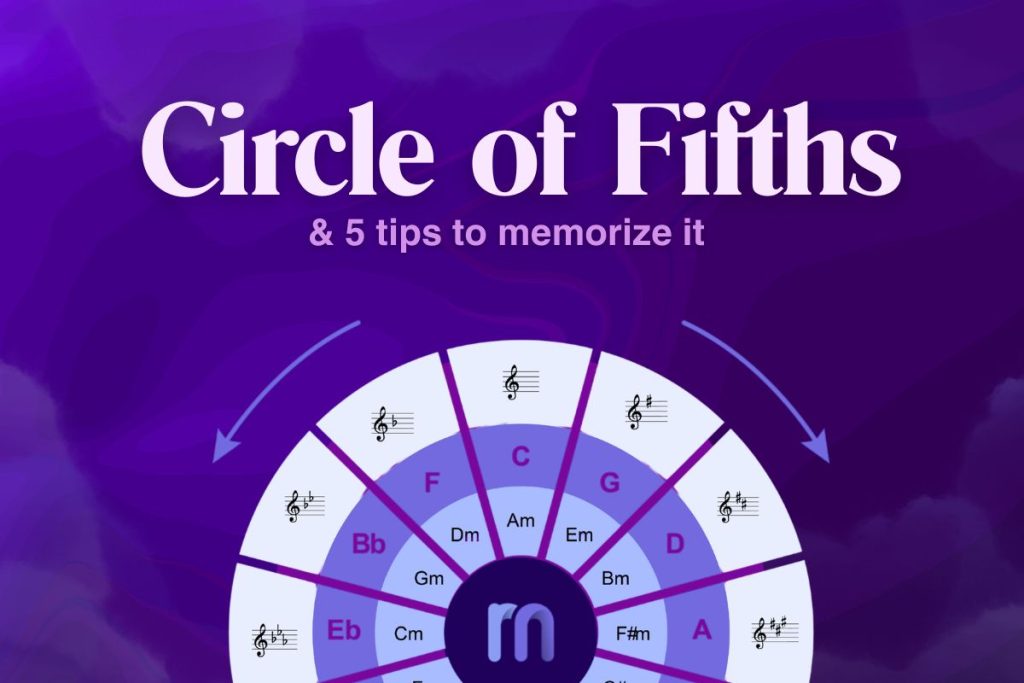
The truth is that the circle of fifths is much simpler than it looks. Once you understand the pattern behind it, it becomes a powerful tool for learning key signatures, building chord progressions, and understanding how different keys connect with each other.
Even better, you do not need to memorize it the hard way. With the right approach, the circle of fifths can become much easier to remember and much more useful in your songwriting or music learning process.
In this blog, we will break down what the circle of fifths really means, why it matters, and share 5 simple tips to memorize it without feeling overwhelmed.
What Is the Circle of Fifths?
The circle of fifths is a visual map that shows how musical keys are connected to each other. It helps you understand key signatures, related major and minor keys, and common chord relationships in a much simpler way than trying to memorize every key one by one.
Generally saying it’s a helpful tool for remembering keys and their key signatures, while some musicians call it one of the most important concepts in music theory because it shows the relationships between keys and chords.
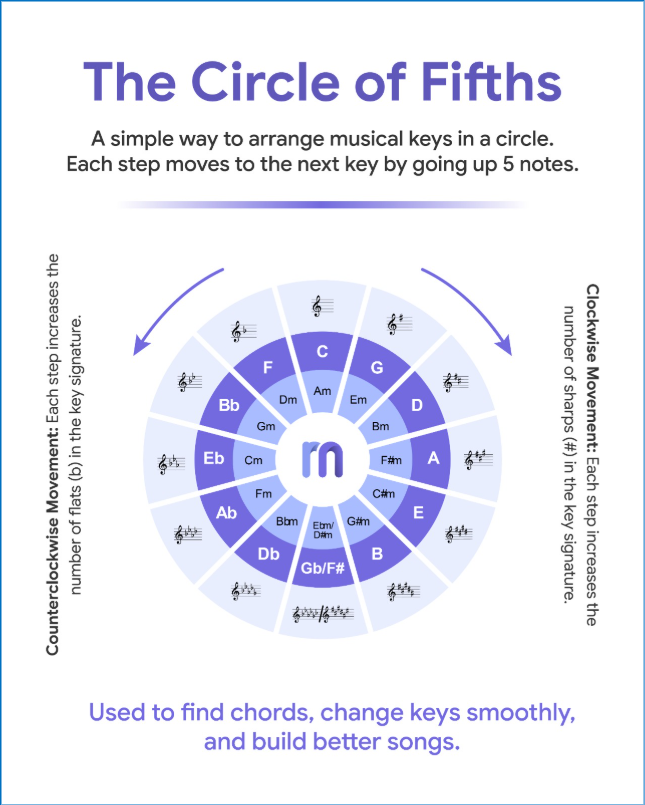
At the top of the circle sits C major, which has no sharps and no flats. From there, you move around the circle to see how keys change.
When you move clockwise, you go up by a fifth each time and add one sharp to the key signature. When you move counterclockwise, you go down by a fifth and add one flat each time.
In simple words, the circle of fifths is not just a theory chart. It is a shortcut for understanding how keys work together in real music. Once you see the pattern, the chart stops feeling random and starts feeling logical.
Why the Circle of Fifths Matters in Music
The circle of fifths matters because it turns a lot of confusing music theory into one clear pattern. Instead of memorizing key signatures, related minors, and chord relationships separately, you can use the circle to see how they connect in one place. It helps musicians understand relationships between keys and chords, which makes it useful far beyond the classroom.
It also helps with practical music-making. The circle can guide you when you are writing chord progressions, identifying a key signature, transposing a song, or choosing chords that sound naturally connected. Chords inside each selected key, which highlights how the circle links theory directly to real harmonic use.
For beginners, the biggest benefit is confidence. The circle can look overwhelming at first, but it becomes much easier once you understand that it is essentially a map of keys. That is what makes it so valuable: it gives you a visual system instead of a pile of disconnected facts.
How the Circle of Fifths Works
The circle works by arranging keys in a pattern based on the interval of a fifth.
Look closely to the circle, Study it for a while ⬆️
Starting from C major, if you move clockwise, the next key is G major. Move another step, and you get D major. Each clockwise move goes up by a fifth and adds one sharp to the key signature.
If you move counterclockwise from C major, you reach F major, then B-flat major, and so on.
Each move in that direction adds one flat. The circle of fifths makes it easy to build the sharp keys, while the circle of fourths explains the flat side. In practice, many musicians treat both ideas as part of the same chart.
This pattern also helps you understand how close or distant two keys feel. Keys that sit next to each other on the circle are more closely related. That is one reason the circle is so useful for chord progressions, songwriting, and modulation. It shows not just what the keys are, but how they connect musically.
See how people get confused here
Major and Minor Keys in the Circle of Fifths
The circle of fifths does not only help with major keys. It also shows the relationship between major keys and their relative minor keys.
Inside the circle you can find the relative minor keys, which share the same key signature as their major relative. For example, C major and A minor both have no sharps or flats.
Relative keys in its circle tool, showing the relative and parallel key for each selected key. That makes it easier to see that one key signature can point to both a major and a minor option.
This matters because beginners often think the circle is only about major scales. In reality, it is also a shortcut for understanding minor keys.
Once you pair each major key with its relative minor, the circle becomes much more useful for songwriting, harmony, and ear training. Instead of memorizing two separate systems, you start seeing them as part of one larger pattern.
5 Tips to Memorize the Circle of Fifths
1. Start with C as your anchor
C major is the easiest place to begin because it has no sharps and no flats. If you can always picture C at the top, the rest of the chart becomes easier to build around it.
2. Learn the clockwise pattern first
Moving clockwise is usually easier for beginners because it follows a clean pattern: each key goes up by a fifth and adds one sharp. Follow the reference image for that. Memorizing one direction first makes the chart feel less overwhelming.
3. Learn the flat side as a second pattern
Once the sharp side feels comfortable, add the counterclockwise side. This side works like a circle of fourths and adds one flat at each step. Treating it as its own pattern helps you memorize it faster.
4. Pair each major key with its relative minor
Do not memorize only the outer ring. Learn the major and minor pairs together, since they share the same key signature. Most of the both emphasize the connection between major and relative minor keys.
5. Use it in real music
The fastest way to remember the circle is to apply it. Use it to identify key signatures, build progressions, or understand why certain chords fit together. We have created an interactive circle, and it will be especially useful because it links each key to its actual diatonic chords.
Common Circle of Fifths Mistakes Beginners Make
A common mistake is trying to memorize the whole circle at once. That usually makes the chart feel harder than it really is. It is much easier to start with C major, then learn the sharp side, then the flat side, and finally add the relative minors. Mostly all the available beginner-focused guide supports this step-by-step way of learning.
Another mistake is memorizing the circle as a visual diagram without understanding what it means. If you know the order of keys but do not understand that clockwise adds sharps and counterclockwise adds flats, the chart stays abstract instead of becoming useful.
Beginners also often ignore the minor keys. But the relative minors are part of what makes the circle practical for real music. When you learn the major and minor connections together, the chart becomes much easier to use in songs, not just in theory exercises.
How to Use the Circle of Fifths in Real Music
The circle of fifths becomes most useful when you stop seeing it as a theory diagram and start using it in actual music. One of its simplest uses is identifying key signatures. Since the circle shows how each step adds a sharp or flat, it gives you a fast way to work out which notes belong to a key.
- It is also useful for songwriting. Keys and chords that sit close to each other on the circle often sound naturally connected, which helps when building chord progressions. The circle helps musicians understand relationships between chords and keys, which is exactly why it is valuable in composition.
- Another real-world use is transposition. If you need to move a song to another key, the circle helps you understand where the new key sits and how closely it relates to the original.
So in practice, the circle of fifths is not just something to memorize for a test. It is a working tool that helps you write, analyze, and understand music more easily.
FAQ
What is the circle of fifths in simple words?
It is a chart that shows how musical keys connect to each other. It helps you understand key signatures, related keys, and common chord relationships.
Why is it called the circle of fifths?
It is called the circle of fifths because moving clockwise around the chart takes you up by the interval of a fifth each time, such as C to G to D.
Do I need to memorize the whole circle?
Not all at once. It is easier to start with C major, then learn the sharp side, the flat side, and finally the relative minor keys.
How does the circle of fifths help with songwriting?
It helps you spot related keys and chords that tend to work well together, which can make chord progressions and key changes feel more natural.
What is the easiest way to remember the circle of fifths?
Use C as your anchor, learn the clockwise pattern first, then add flats and relative minors. It also helps to use the circle in real songs instead of memorizing it in isolation.