
Drum and bass is one of the most physical genres in modern music. The drums are faster than your heart, wants to beat. The sub-bass rolls under everything, low enough that you feel it before you hear it. When the drop hits, the room moves.
You can read about it. But mostly, you have to hear it.
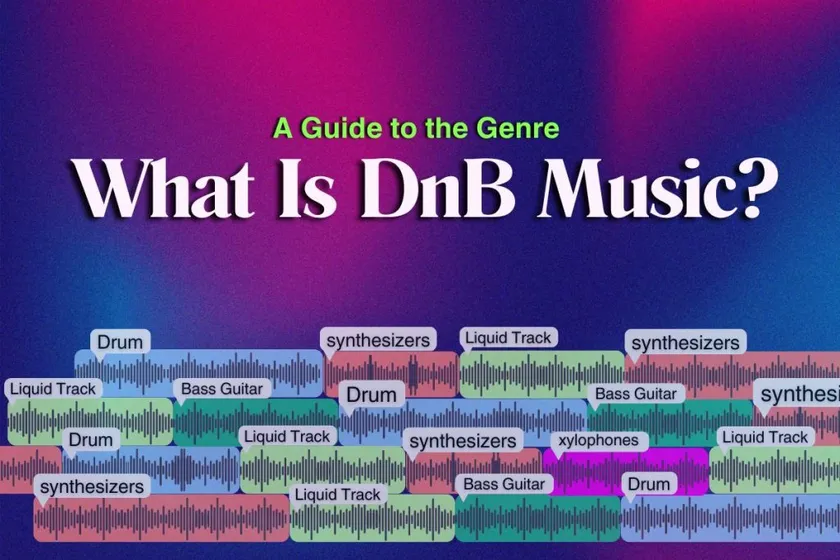
This guide is for anyone who has heard the name and wants to actually understand it. Where it came from. Why it sounds the way it does. Who is making it now. And how to start listening with ears that know what to listen for.
By the end, you will know how to spot drum and bass inside three seconds of a song.
📌 A Quick Answer to What Is Drum and Bass
Drum and bass (often shortened to DnB or D&B) is a genre of electronic music built around fast breakbeats at 160 to 180 BPM, deep sub-bass, and a buildup-drop-breakdown structure. It originated in the United Kingdom in the early 1990s, growing out of the rave and jungle scenes. What sets it apart from other electronic music is the combination of speed and weight — full-tempo drums at 170 BPM with sub-bass deep enough to move air, where house sits at 120 BPM and techno at 130. The rest of this post tells you what to listen for.
The Sound of Drum and Bass
Once you know what to listen for, drum and bass becomes unmistakable. Four elements define the genre.
ᯓ➤ Tempo: 160 to 180 BPM
Drum and bass lives in a narrow tempo range. Most tracks sit between 170 and 175 BPM. Slower than that, the energy drops. Faster than that, the drums start to blur.
This tempo is not arbitrary. It is roughly twice the speed of a comfortable walking pace, which gives the genre its forward-motion feel. Your body cannot help but respond. Other electronic genres lean on slower tempos (house at 120, techno at 130, dubstep at 140), but drum and bass commits fully to fast, and the commitment is part of the identity.
ᯓ➤ Breakbeats and the Amen Break
The drum patterns in DnB are built from chopped and reprogrammed funk breaks, not the steady four-on-the-floor kick of house or techno. The single most influential drum sample in the genre’s history is the Amen break, a six-second drum solo from a 1969 B-side by The Winstons.
According to WhoSampled’s database, it has been used in over 6,000 tracks. If you have heard drum and bass, you have heard the Amen break, often without realizing it.
Modern producers layer, retrigger, and program drums into intricate patterns that move forward without ever settling into a repetitive groove. The drums are the architecture.
ᯓ➤ Sub-Bass That You Feel, Not Hear
The bass in DnB sits below most other electronic genres. Frequencies between 30 and 80 hertz dominate. These are sounds that small speakers (phones, laptops, earbuds) cannot fully reproduce. They are designed for systems with subwoofers, where the bass becomes a physical experience rather than a sonic one.
This is why DnB sounds underwhelming on cheap speakers and transformative on club rigs. The genre was built for the latter.
ᯓ➤ The Structure: Build, Drop, Breakdown
A typical DnB track follows a three-part dynamic arc. The buildup introduces drums, bass elements, and tension. The drop is the moment everything lands at full force, usually around the 60 to 90 second mark. The breakdown strips back the energy, often to atmospheric pads or vocals, before building back into another drop.
That structure is the genre’s emotional architecture. The drop only hits if the breakdown earned the contrast.
Where Drum and Bass Came From
Drum and bass grew out of the early 1990s UK rave scene. Producers chopping funk breakbeats and speeding them up over deep basslines created a sound called jungle, which by the mid-1990s had evolved into what we now call drum and bass. The genre crossed into the mainstream in 1995 with Goldie’s debut album Timeless, and it has been a defining force in electronic music ever since.
That is the short version. For the full story — the Jamaican sound system influence, the Amen break’s role, the artists who built the scene, and how jungle split into drum and bass — read our full piece on how drum and bass was born.
The Subgenres of Drum and Bass
Once drum and bass had a core sound, it began to fracture. Today, the genre is more accurately described as a family of related styles.
- Liquid funk is the soulful and atmospheric end of the spectrum. Lush pads, emotional vocals, melodic basslines. Producers like Netsky, High Contrast, and London Elektricity built careers here.
- Jump-up is the rowdy, crowd-driving end. Warped basslines, party-ready energy, aggressive arrangements. Artists like Bou, Turno, and Hedex dominate this lane.
- Neurofunk is darker and more synthetic. Mechanical, industrial, often menacing. Noisia, Phace, and Black Sun Empire are foundational names.
- Techstep sits between hardcore and neurofunk. Harder than liquid, less synthetic than neurofunk. Pioneered by Ed Rush, Optical, and Trace in the mid-1990s.
- Drumfunk is the experimental, sample-chopping end of the genre. Producers like Photek built it from intricate breakbeat manipulation.
Many modern producers blend across these subgenres rather than committing to one. The lines have softened over time, but the labels still matter when you are starting to listen.
Drum and Bass vs Other Genres
Beginners often confuse drum and bass with related electronic genres. Here is how to tell them apart.
⤷ Drum and Bass vs Jungle
Jungle is the predecessor. Same tempo range, similar breakbeat-driven drums, deeper reggae and ragga vocal influence, rougher production. Drum and bass is the cleaner, more refined evolution that emerged in the mid-1990s. The genres overlap heavily and many tracks could be filed under either.
⤷ Drum and Bass vs Dubstep
Dubstep is half the tempo (around 140 BPM with a half-time feel that often makes it feel like 70 BPM). DnB is full-tempo, around 170 BPM. Dubstep is built around sparse wobble bass and dramatic drops. DnB is built around relentless drum patterns and forward motion. Both are bass-heavy UK electronic genres, but they feel entirely different on a dance floor.
⤷ Drum and Bass vs Breakbeat
Breakbeat is a broader category that includes any genre built on broken-up funk drum patterns. DnB is a specific subgenre of breakbeat with a defined tempo range and bass-forward identity. All drum and bass is breakbeat. Not all breakbeat is drum and bass.
Major Drum and Bass Artists to Know
A practical reference for beginners who want to start listening, organized by era.
The pioneers (1990s). Goldie, Roni Size, LTJ Bukem, Andy C, Dillinja, Shy FX, Photek, 4hero. These artists built the genre’s foundational vocabulary.
The 2000s and 2010s. Pendulum, Sub Focus, Netsky, Chase & Status, High Contrast, London Elektricity. The era when DnB crossed further into the mainstream and developed its modern production sheen.
Contemporary artists. Dimension, Bou, Hedex, A.M.C, Koven, Worship, Sub Focus (still active), Tantrum Desire, Chase & Status (still active), Wilkinson, Bensley. The producers shaping the genre today.
If you are unsure where to start, Pendulum’s Hold Your Colour (2005) is one of the most accessible entry points into the genre. Goldie’s Timeless (1995) is the historical landmark. Netsky’s self-titled debut (2010) is the cleanest introduction to liquid funk.
How to Start Listening to Drum and Bass
Three practical ways to start.
- Streaming playlists. Spotify’s “New Music Friday Drum & Bass,” “DnB Drive,” and “Drum and Bass Hits” playlists are well-curated entry points. Apple Music has equivalent editorial playlists.
- Labels. RAM Records, Hospital Records, Shogun Audio, and Critical Music release a large portion of contemporary DnB. Following any of them on streaming services is a fast way to discover new tracks.
- Live sets. UKF on YouTube hosts a massive archive of recorded DJ sets and tracklists. Hospital Records and RAM Records both have official YouTube channels with current releases. Watching a 30-minute mix gives you the rhythm of the genre faster than any playlist can.
The most important thing is to listen on a system that does the bass justice. Phone speakers and basic earbuds will not give you the genre. Headphones with real bass response, a car stereo with a subwoofer, or a club system are how DnB was meant to be heard.
How Drum and Bass Tracks Get Made
Behind every DnB track is a production journey that starts with software and ends with a release-ready master. If you are curious about the craft side of the genre, here is how the pieces fit together.
👉 The DAW. Most producers work in Ableton Live, FL Studio, Bitwig Studio, or Logic Pro. Each tool has its own strengths for the genre. Our guide to the best DAWs for producing drum and bass breaks down what each one is genuinely good at and how to choose.
👉 Mixing. Drum and bass is one of the hardest genres to mix cleanly because the sub-bass, the bassline, the kick, and the breakbeats all compete in the same frequency space. Getting them to coexist takes specific techniques. Our guide on how to mix drum and bass covers the engineering decisions that prevent the mix from going muddy.
👉 Mastering. The final stage. Mastering DnB for streaming is uniquely difficult because the genre’s traditional loudness clashes with how streaming platforms normalize tracks. Our guide on how to master drum and bass for streaming covers the LUFS targets, true peak limits, and limiter strategy the genre requires.
If you want to go deeper on any of these stages, those three posts are the natural next steps.
Why Drum and Bass Still Matters
Thirty years after it was born, drum and bass is more relevant than at any point in the last two decades.
TikTok virality has introduced the genre to a generation that did not grow up with it. Festival main stages now book DnB artists alongside the biggest names in pop and hip hop. Bedroom producers around the world are making the genre on laptops, sharing it on SoundCloud and YouTube, and finding audiences without a label or a manager. The infrastructure that once required warehouses, pirate radio, and underground networks now lives on phone screens.
What has not changed is the feeling. The drums are still faster than your heart wants to beat. The sub-bass still moves air. The drop still lands when the breakdown earns it. A genre built in the early 1990s still works because the physics of how human bodies respond to fast drums and deep bass has not changed.
The genre that started in warehouses is now living on phone speakers, festival stages, and headphones around the world. And it is still loud.
Final Words
Drum and bass is not a genre you understand from reading. It is a genre you understand from listening.
The guide above gives you the vocabulary. The artists give you the entry points. The cluster posts give you the depth. But the only way to actually know drum and bass is to hit play on a track loud enough to feel it.
Put it on. Listen for the breakbeats. Wait for the drop. Let the bass do what it was built to do.
Now that you know what drum and bass is, the next move is to listen, then to make.
When you reach the master stage, Remasterify is built for the genre’s specific demands. One file, every platform, in a few minutes.
(will take less than 30 seconds)