
Drum and bass has a streaming problem.
The genre was originally built loud. Club systems, festival rigs, late-night sets where the bass needed to physically move the room.
For thirty years, drum and bass producers mastered their tracks hot — often pushing well past -10 LUFS. That was the standard, and the genre’s identity was partly bound up in that loudness.
Later on, streaming changed the rules.
📌 What is mastering Drum and Bass for streaming?
Mastering drum and bass for streaming is the final stage where you prepare your finished mix to sound right on platforms like Spotify and Apple Music. Since these platforms normalize loudness automatically, the goal is to balance loudness, headroom, and punch so the track keeps its weight after the platform adjusts it.
Spotify, Apple Music, and every major platform now use loudness normalization. They measure your track, decide it’s too loud, and turn it down before the listener ever hears a note. A drum and bass track mastered the traditional way doesn’t just get penalized. It often ends up sounding worse than a less-aggressive master, because the loudness it was built around is gone, and what’s left is the compression damage the loudness was hiding.
This post is about how to master drum and bass for streaming in 2026. So, what targets to hit, why the genre is uniquely difficult, and how to keep the heaviness the genre is built on without the platforms fighting you.
If you haven’t read the rest of our drum and bass cluster, start with our Beginner’s Guide to Drum and Bass or our post on how to mix drum and bass.
TL;DR
- Master to -14 LUFS integrated. It matches Spotify, YouTube, Tidal, and Amazon Music. Apple Music is -16, but one master at -14 works everywhere.
- Set true peak at -1 dBTP, or -1.5 to -2 dBTP for DnB. Sub-bass and sharp transients create inter-sample peaks that clip after codec conversion. Extra headroom protects the master from streaming distortion.
- Don’t use one brickwall limiter to do all the work. Soft-clip the transient peaks first, then let the brickwall hold the ceiling. One limiter doing everything kills the kick punch and sub weight.
- Protect the drop. Keep at least 4 to 6 dB of short-term LUFS difference between the breakdown and the drop. Heavy mastering compression flattens the genre’s emotional architecture.
- Don’t master louder than -10 LUFS. Streaming platforms turn you down, and the compression damage stays after the loudness is gone.
- One master, every platform. -14 LUFS, -1 dBTP, 24-bit WAV. No need for separate files per service.
Why Drum and Bass Is Harder to Master for Streaming Than Most Genres
Three reasons, and they compound.
The genre is louder than streaming wants. Most modern pop sits at -10 to -12 LUFS before mastering, which is already loud. Drum and bass historically pushes to -8 LUFS or hotter. Spotify normalizes everything to -14 LUFS. That means a traditional DnB master gets turned down 6 dB or more, which exposes every compression artifact the loudness was hiding.
The sub-bass and the transients fight inside the limiter. Drum and bass has the deepest sub-bass content of any popular genre, combined with some of the sharpest drum transients (breakbeats, snares, hi-hats). A single brickwall limiter set to catch true peaks hits both elements at the same time. The kick loses its punch. The sub loses its weight. The genre’s defining sonic features get sacrificed to the loudness target.
True peak management is harder. Sub-bass produces inter-sample peaks that don’t show up on a regular peak meter but show up after the lossy codec conversion streaming platforms use. A DnB master that looks clean in your DAW can clip after Spotify’s encoder gets to it. This isn’t theoretical. It’s a regular reason DnB tracks sound distorted on streaming when they sound clean on local playback.
The rest of this post is about how to solve all three problems.
The LUFS Target for Drum and Bass on Streaming
Every streaming platform measures your track’s loudness in LUFS (Loudness Units Full Scale) and normalizes it to a target. If you’re new to LUFS, our full guide on mastering with a LUFS meter covers the fundamentals. Here’s what matters for DnB specifically.
The Platform Numbers Every DnB Producer Should Know
- Spotify normalizes to -14 LUFS integrated.
- Apple Music sits at -16 LUFS through its Sound Check feature, two decibels quieter than Spotify.
- YouTube Music normalizes to around -14 LUFS.
- Tidal targets -14.
- Amazon Music sits in the same range.
- Deezer is also close.
The numbers are converging. A track mastered to -14 LUFS integrated with a true peak of -1 dBTP will work cleanly across every major platform. You don’t need separate masters for each.
Why -14 LUFS Isn’t Always Right for DnB
Here’s the honest tension.
Drum and bass exists in playlists with other DnB. A track mastered exactly to -14 LUFS will feel quieter than the genre’s traditional masters sitting around -10. Streaming platforms normalize integrated LUFS but not short-term loudness, so a louder master can still feel louder in a playlist context, even after normalization.
The cost is dynamic damage. Push past -11 LUFS and the limiter has to do more work. The drop loses impact. The drums lose air.
The honest answer is: master to -14 LUFS as a baseline. If the track feels weak next to other DnB in a playlist, push to -12 or -11. Going louder than -10 is almost never worth it for streaming in 2026.
True Peak Limits and Why DnB Gets Caught
The -1 dBTP Standard
Every major streaming platform expects a true peak ceiling of -1 dBTP or quieter. Spotify recommends -1. Apple Music recommends -1. The reason is the same across all of them: when audio gets converted to lossy formats (AAC, MP3, Vorbis), inter-sample peaks can exceed the original peak by 1 to 2 dB. A master peaking at -0.1 dBTP in your DAW can clip after streaming encoding.
Set your final limiter ceiling to -1 dBTP. That’s the floor for streaming safety.
Why DnB Tracks Clip on Spotify Even When Your Master Doesn’t
For DnB, -1 dBTP isn’t always enough.
Sub-bass produces inter-sample peaks more aggressively than other frequencies because of the long wavelengths involved. Sharp drum transients add another layer of peak energy that survives codec conversion. The combination is the worst case for true peak management.
For DnB specifically, consider a ceiling of -1.5 dBTP or even -2 dBTP. You lose a small amount of perceived loudness. You gain immunity from codec clipping.
👉 Your ears judge loudness by the average level (RMS) of a sound, but your computer and analog gear care about the loudest spike, the peak. When a peak crosses a certain ceiling called the clipping point, the gear distorts even if the track sounds fine to you. Mastering means pushing the RMS up so the track feels loud, while keeping the peaks below that ceiling so it stays clean.
The tradeoff is almost always worth it. Our guide on headroom in audio covers the broader logic of leaving safety margin in a master.
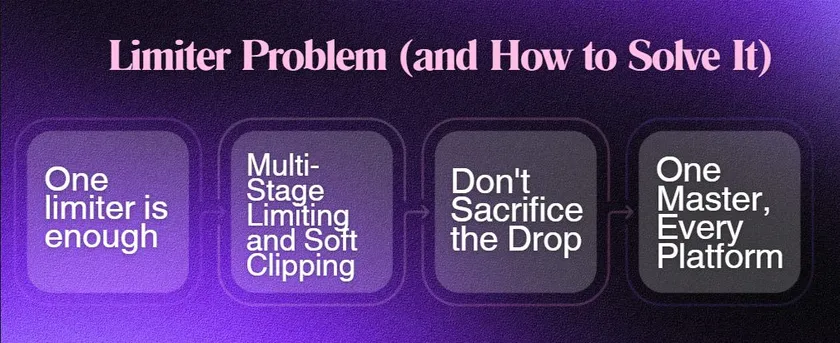
The Limiter Problem (and How to Solve It)
This is the section that matters most for the genre.
Why a Single Brickwall Limiter Kills DnB
A traditional mastering chain ends in one brickwall limiter set to catch transients and hold the ceiling. For pop, rock, and most electronic music, one limiter is enough.
For drum and bass, one limiter is a problem.
The sub-bass and the drum transients both hit the limiter at the same threshold. Every kick drum hits the limiter. Every snare hits the limiter. The sub-bass is constantly hitting the limiter. The limiter responds to all of them by attenuating. The result is a master where the kick has no punch, the snare has no snap, and the sub feels smaller than it did in the mix.
The loudness is there. The character isn’t.
Multi-Stage Limiting and Soft Clipping
The solution is splitting the work across two stages.
Stage one is a soft clipper or saturator placed before the limiter. It rounds off the sharpest transient peaks (kick clicks, snare cracks) by gently distorting them. The distortion is minimal — a few hundredths of a decibel — and inaudible in context. But it cuts the transient energy that would otherwise hit the limiter hardest.
Stage two is the brickwall limiter, doing far less work. With the transient peaks already softened, the limiter can hold the ceiling without crushing the drums.
This is how professional DnB mastering engineers preserve punch at competitive loudness. One limiter doing everything is the bottleneck. Two stages working together is the solution.
Don't Sacrifice the Drop
Drum and bass is a genre of dynamic architecture. The breakdown is quiet. The drop is enormous. The contrast is part of why the genre hits.
Heavy mastering compression flattens that contrast. The breakdown gets louder. The drop gets quieter. Both end up at the same level, and the emotional impact of the drop disappears.
The fix is restraint at the mastering bus compressor. Use slow attack, moderate ratio, and aim for 2-3 dB of gain reduction at the loudest moments. The compressor should be glue, not loudness. Keep at least 4-6 dB of short-term LUFS difference between the breakdown and the drop. The integrated LUFS still hits -14. The dynamic story stays intact.
One Master, Every Platform
You don’t need to make five different masters for five different platforms.
One master at -14 LUFS integrated, -1 dBTP, 24-bit WAV will work across Spotify, Apple Music, YouTube Music, Tidal, Amazon Music, and Deezer. Making separate masters per platform creates more problems than it solves — phase inconsistencies between versions, distribution headaches, and the risk that one version sounds noticeably different from another in a playlist context.
Master once. Master well. Let the platforms do their normalization. The math works.
AI Mastering vs Manual Mastering for DnB
The honest answer is that both work, and the right choice depends on the project.
AI mastering is genuinely strong for DnB in three situations. 👇
👉 First, when you’re iterating on multiple versions of a track and need fast, consistent results without paying per-revision.
👉 Second, when you’re releasing singles or EPs where the budget for a human mastering engineer isn’t justified.
👉 Third, when your mix is already clean and you mainly need a competent final stage to handle loudness, ceiling, and translation.
Manual mastering still wins in three other situations. 🤝
✊ First, on album-length releases where every track needs bespoke decisions to flow together as a record.
✊ Second, when you want creative input on the mastering aesthetic — a specific engineer’s signature sound.
✊ Third, on signature releases where the mastering itself is part of the artistic identity of the project.
For the vast majority of bedroom DnB producers — the audience this post is written for — AI mastering covers the ground you actually need. The cost is lower, the iteration speed is higher, and the quality is now close enough to manual mastering that the difference is usually not worth the price gap on a streaming single.
Our broader take on this is in why music mastering costs so much.
Common DnB Mastering Mistakes
A quick checklist of what to avoid.
- Mastering louder than -10 LUFS thinking it’ll help on streaming. It won’t. The platforms will normalize you down and the only thing left is the damage.
- Setting the limiter ceiling at -0.3 dBTP instead of -1 dBTP. Codec conversion will create inter-sample peaks that clip on lossy playback.
- Crushing the breakdown-to-drop dynamic. The drop has to feel like a drop. If your compressor is doing 6 dB of gain reduction at the loudest moments, the drop is already dead.
- Forgetting to check the master in mono. Bluetooth speakers, club mono sums, and many car systems collapse the low end to mono. If your master falls apart in mono, it’ll fall apart in the real world.
- Mastering before the mix is genuinely clean. Mastering cannot fix a muddy mix. If you haven’t read it yet, our post on how to master your track in 5 steps covers the order of operations that prevents this.
Final Words
Drum and bass is one of the hardest genres to master for streaming. The platforms don’t care about the genre’s traditions. They care about their normalization targets. A producer who understands the rules gets to bend them on purpose.
Master to -14 LUFS integrated. Keep the true peak at -1 dBTP. Split the limiting work across two stages so the drums and the sub don’t fight inside the same plugin. Preserve the dynamic between the breakdown and the drop. One file, every platform.
When the master is done, the track stops being a project and starts being a release.
Drum and bass deserves a master that holds its weight on every platform.
Remasterify can take your final mix and deliver a release-ready master in a few minutes, with the loudness, headroom, and translation the genre demands.
Some FAQs
1. What LUFS should I master drum and bass to for Spotify?
Aim for -14 LUFS integrated, which matches Spotify’s normalization target. You can push to -12 or -11 LUFS if your track feels too quiet next to other DnB in a playlist, but going louder than -10 LUFS rarely helps. The platform turns you down, and what’s left is the compression damage the loudness was hiding.
2. Why does my drum and bass track sound distorted on Spotify even though the master is clean?
Lossy codec conversion creates inter-sample peaks that didn’t exist in your WAV file. Drum and bass is especially vulnerable because of the deep sub-bass and sharp drum transients. Set your true peak ceiling to -1 dBTP at minimum, or -1.5 to -2 dBTP for extra safety. That headroom prevents the codec from clipping your master on playback.
3. Should I make separate masters for Spotify, Apple Music, and YouTube?
No. One well-mastered file at -14 LUFS integrated and -1 dBTP will work across every major streaming platform. Making separate masters per platform creates more problems than it solves, including phase inconsistencies between versions and distribution headaches. Master once, master well, and let each platform handle its own normalization.
4. How loud should the drop be compared to the breakdown in a mastered drum and bass track?
Keep at least 4 to 6 dB of short-term LUFS difference between the breakdown and the drop. The integrated LUFS can still hit -14, but the dynamic story should stay intact. Heavy mastering compression that flattens the drop kills the genre’s entire emotional architecture. Use slow attack, moderate ratio, and aim for no more than 2-3 dB of gain reduction at the loudest moments.
5. Is AI mastering good enough for drum and bass?
For most bedroom producers, yes. AI mastering handles loudness, headroom, and translation reliably, and the iteration speed is far higher than working with a human engineer. Manual mastering still wins on album-length releases, signature artistic projects, or when you want creative input on the mastering aesthetic. For singles, EPs, and most streaming releases, AI mastering covers the ground you actually need.
6. What’s the biggest mistake producers make when mastering drum and bass for streaming?
Trying to master too loud. Producers see other DnB tracks sitting around -8 LUFS and assume that’s the target. It isn’t. Streaming platforms turn loud tracks down, and the damage from over-compression stays after the loudness is gone. The result is a master that sounds worse than a more dynamic version would have. -14 LUFS integrated is the baseline. Push slightly louder only if the track demands it.
Last Updated: