
In 2019, Billie Eilish and her brother Finneas released “Bad Guy” from a bedroom in their family home in Los Angeles.
What made it strange wasn’t the sound. It was the shape. The hook has no lyrics. The chorus is a whispered melody over a bassline. There’s a full genre change in the final third. It doesn’t behave like a hit song is supposed to behave, and it beat every song that did.
That’s not an isolated case. It’s the direction songwriting has been moving for the last six years.
The verse-chorus-verse-chorus-bridge-chorus structure that shaped songwriting for fifty years is no longer the default. Streaming platforms, short-form video, and the sheer volume of new music released every day have changed what actually works.
It went to number one on the Billboard Hot 100 and became the biggest streaming hit of that year.
This post is a fresh look at where songwriting structure stands in 2026, what the classic templates are missing, and what indie artists releasing music today should actually build.
✨ What is songwriting structure?
Songwriting structure is the order and arrangement of a song’s sections — verse, chorus, bridge, and others. For example, Adele’s “Hello” follows a classic verse-chorus-verse-chorus-bridge-chorus format.
🤏 Summary
- The old verse-chorus-bridge structure is no longer the default. Streaming and short-form video have changed what actually works.
- The first 30 seconds decide everything. Long intros lose listeners before the algorithm even counts the play.
- Choruses have to hook faster. One clear idea, strong melody, payoff early. Bridges only earn their place when the song genuinely needs them.
- Different genres use different structures. Hip hop leans on verse-hook, EDM builds around drops, and modern pop keeps getting shorter.
Why the Old Song Structure Is Losing Ground
The classic structure was built for radio. A verse to introduce the story, a chorus to deliver the hook, a bridge to break the monotony, all wrapped in a three-and-a-half-minute package designed for airplay. It worked because the listener was captive. If a song came on the radio, most people heard the whole thing.
Streaming broke that assumption.
Today’s listener has a skip button and endless alternatives. According to Chartlex campaign data, tracks with a skip rate above 35% in the first 30 seconds receive measurably less algorithmic distribution — fewer Radio placements, suppressed Autoplay recommendations, and near-zero Discover Weekly inclusion.
The 30-second mark is a documented threshold where listener behavior gets weighted as a negative signal. That single change has reshaped how songs are written. Long instrumental intros are gone. Slow builds have been shortened. Choruses show up faster. The bridge, once the emotional heart of a great song, is now the section most likely to be cut entirely.
Your existing framework on the classic structure still applies as a foundation. Our post on song arrangement for beginners walks through the intro, verse, pre-chorus, chorus, bridge, and outro. What follows is what those sections actually look like in 2026.
When Does a Song Need a Bridge?
The bridge is the most-questioned section in modern songwriting.
For decades, the bridge was where a great song earned its final chorus. It broke the pattern. It shifted the emotion. It gave the listener a reason to hear the hook one more time. Today, plenty of chart-topping songs skip the bridge entirely.
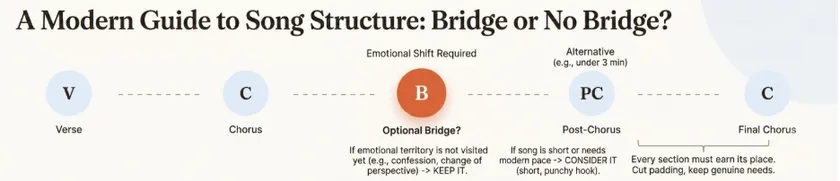
Here’s the honest answer to when a song needs one.
- A bridge earns its place when the song has emotional territory it hasn’t visited yet. If the verse and chorus have already covered every angle of the story, a bridge just delays the ending. But if there’s a shift the song is building toward — a confession, a change of perspective, a resolution — the bridge is where it lives.
- Skip the bridge when the song is already short. Modern pop songs regularly clock in under three minutes. Adding a bridge to a 2:30 song often means padding it past the point where the listener’s attention holds. Better to end strong than stretch thin.
- Consider a “post-chorus” instead. In modern structure, the post-chorus — a short, punchy hook that lands right after the chorus — has quietly replaced the bridge for a lot of songs. It gives the listener a reward without asking them to sit through a slower section.
The rule isn’t “bridges are outdated.” The rule is that every section has to earn its place. If a bridge is there because you were taught to include one, cut it. If it’s there because the song genuinely needs it, keep it.
How to Write a Chorus That People Actually Remember
The chorus is doing more work than ever.
In the streaming era, listeners decide fast. If they’re not hooked by the chorus on the first listen, they skip. If they don’t remember it a day later, they don’t come back. The chorus has to accomplish in fifteen seconds what songs used to have three minutes to do.
Three practical rules from modern chart analysis.
- One clear idea
The chorus should say one thing. Not three ideas layered over each other. Not a metaphor stacked on a metaphor. One line, one feeling, one memory the listener carries away.
- Melody first, lyrics second
The chorus melody should be strong enough that a listener could hum it after one listen with no lyrics attached. If the melody doesn’t stand alone, the words won’t save it. Our guide on how to write a song worth releasing covers the deeper principles of writing lines that survive the recording process.
- Repetition without boredom
The most memorable choruses repeat the same phrase or melody multiple times within the chorus itself.
Think about how Eilish repeats “duh” throughout the “Bad Guy” chorus. She actually recorded 34 different takes of the word. The repetition became the hook. It’s not lazy songwriting. It’s designed retention.
[Another important thing] Get the payoff early. In older songwriting, the “money line” of the chorus often landed at the end. In modern structure, it lands first. The listener needs to hear the strongest moment immediately.
Once you’ve written a chorus that hooks, the next problem is making sure it sounds finished. A great chorus with a flat, unmastered production loses the impact it earned. Remasterify can take your finished mix and master it to competitive streaming loudness in minutes, so the hook you wrote lands the way it should.
Why the First 30 Seconds of Your Song Matter Most
Every songwriter releasing music in 2026 should understand this rule.
According to Spotify’s own Loud & Clear report (2025), the average listener decides whether to skip a song within the first 5 to 10 seconds of playback.
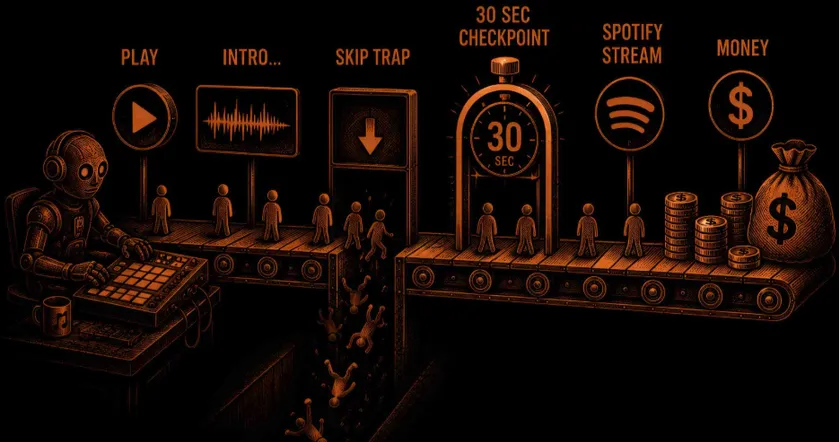
Chartmetric’s 2025 analysis of over 4 million independent releases found that tracks with intros longer than 20 seconds had a 38% higher skip rate than those that delivered a vocal or melodic hook within the first 15 seconds.
On top of that, Spotify only counts a play as a stream if the listener stays past the 30-second mark. Skip before then, and it doesn’t register at all.
This has changed how modern songs are structured at the front end.
👉 Intro is now measured in seconds, not bars
A four-bar instrumental intro at 90 BPM already consumes over 10 seconds. Most modern hits drop a hook, a vocal, or a distinctive sonic element within the first 5 seconds.
“Bad Guy” opens with the bassline immediately. “Blinding Lights” hits its signature synth in the first two seconds. There’s no runway anymore.
👉 Pre-chorus has become optional
Some songs still use one to build tension. Many skip it entirely and let the verse lead directly into the chorus.
👉 First line of the verse matters as much as the chorus used to
If the opening lyric or melodic phrase doesn’t earn attention, the listener never reaches the hook. This is a real shift from earlier eras where the chorus was allowed to do all the heavy lifting.
The takeaway is simple. If you’re spending twenty seconds building atmosphere before your song starts, you’re losing listeners before the algorithm can even register that they were there.
How Song Structure Changes Across Genres
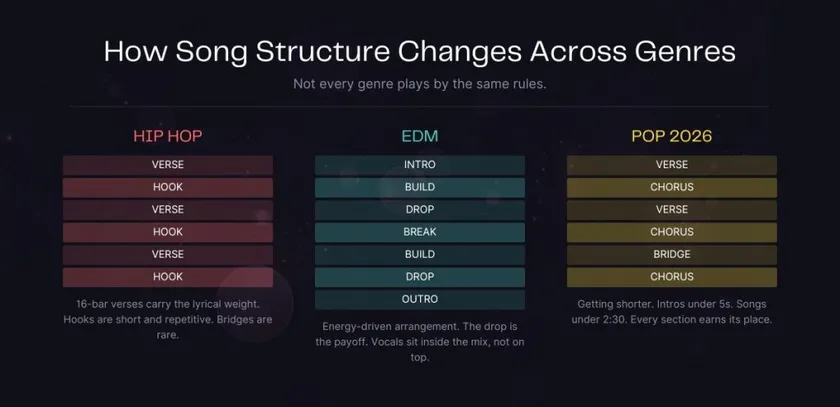
Not every genre plays by the same rules. Here’s what changes across three of the biggest streaming genres.
Hip Hop Song Structure
Hip hop rarely uses the traditional verse-chorus-bridge-chorus format.
- The common structure is verse-hook-verse-hook-verse-hook, with the hook doing the work a chorus would in pop.
- The verses are longer than pop verses, often 16 bars, and they carry the entire lyrical weight of the song.
- The hook is shorter, more repetitive, and built to be memorable in isolation.
- Bridges are rare. When they exist, they’re usually a shift in beat or a brief spoken interlude rather than a melodic contrast.
- The intro is often just a producer tag, an ad-lib, or a two-bar beat drop. Rarely more than five seconds.
The reason is the same as everywhere else: the listener has to commit to the track fast.
EDM Song Structure
Electronic music uses a completely different framework.
- The dominant structure for EDM is intro-build-drop-breakdown-build-drop-outro.
- The intro sets a rhythmic foundation, usually just a beat or a chord loop. The build introduces tension, layering elements and often adding a riser or filter sweep. The drop is the payoff — the moment the full arrangement lands.
- The breakdown strips it back to atmosphere before another build sends the track into a second drop.
- Vocals, when present, sit inside the arrangement rather than driving it. The “song” in an EDM track is the arrangement of energy, not the melody.
Our post on how to master drum and bass for streaming covers how the drop-based structure translates to mastering choices.
Pop Song Structure in 2026
Modern pop is getting shorter.
Data from hit songs between 1986 and 2015 shows the average intro length has decreased from over 20 seconds to about 5 seconds. The trend has continued since.
Songs under 2:30 are now common on the charts. Some hit songs run barely over 2 minutes.
The classic pop structure still exists — verse, chorus, verse, chorus, bridge, chorus — but it’s been compressed. Verses are shorter. Choruses hit sooner. Bridges are often reduced to four bars or removed. The trend is toward fewer sections, each doing more work in less time.
The best modern pop songs write around this compression rather than fighting it. They don’t lament that songs are shorter. They accept the format and design every section to earn its place.
The Only Structure Rule That Still Applies
Every rule about song structure comes back to one principle. The listener has to want the next moment.
That’s what the classic structure was trying to do with the verse leading to the pre-chorus leading to the chorus. It’s what modern pop is doing when it drops the hook in the first five seconds. It’s what hip hop is doing with tight verse-to-hook returns. It’s what EDM is doing with its build-and-drop framework.
Structure is not about following a template. It’s about designing a listening experience where every section pulls the listener into the next one. If your song does that, the structure works. If it doesn’t, no template will save it.
Let’s wrap it up
The song structure playbook that dominated popular music for fifty years is not gone. It’s just not the only option anymore.
What “Bad Guy” proved in 2019, and what the streaming era has confirmed since, is that a song can break every rule of traditional structure and still land at the top of the charts — if it earns the listener’s attention at every moment. That’s the real test.
Not whether your song has a bridge or a pre-chorus or a four-bar intro. Whether the next moment in your song is the one the listener wants to hear.
Mastering is what makes your track hit as hard on Spotify as it does in your headphones.
Once your song is written, arranged, and mixed, the last stage is mastering. Remasterify is built for this stage, with AI mastering that handles loudness, headroom, and translation across every streaming platform. Upload your track and hear it finished in a few minutes.