
We’re assuming…
You bounce a mix and hear a low hiss under the quiet parts. You solo a vocal and hear the room. Between takes, the waveform shows something that isn’t quite silence.
Every producer runs into this. And every producer eventually asks the same question. Is my noise floor normal, or is something wrong with my setup?
The real answer depends on your room, your gear, your material, and what you plan to do with the track downstream.
A noise floor that ruins an acoustic ballad is invisible on a dense metal mix. A number that works for streaming can fall short of what an ACX audiobook needs.
This post covers what noise floor actually is, what’s normal for a bedroom setup, why it gets worse the moment you try to hit a loudness target, and what mastering can and can’t do about it.
Four situations pulled from real producer forum discussions show how this plays out in practice.
Summary
- Noise floor is the sum of all the noise your recording setup produces with no signal running through it. For most bedroom producers, -55 to -68 dBFS is normal territory.
- Every dB of gain you apply to a signal raises the noise floor by the same amount. A clean -60 dBFS baseline becomes -40 dBFS the moment loudness normalization kicks in.
- Match your noise floor concern to the material. It ruins acoustic ballads and voiceover work. It’s invisible under dense metal and EDM productions.
- Mastering can polish noise floor with denoising and dynamic control. It can’t remove noise blended into the mix or undo a bad recording. The noise floor of your master is set by the source.
What Noise Floor Actually Is
Before the case studies, a fast definitional pause.
Noise floor is the sum of all the noise your recording setup produces when no signal is running through it. It includes room noise, HVAC, computer fans, microphone self-noise, preamp hiss, ground loops, and electromagnetic interference. Everything that isn’t your intended signal.
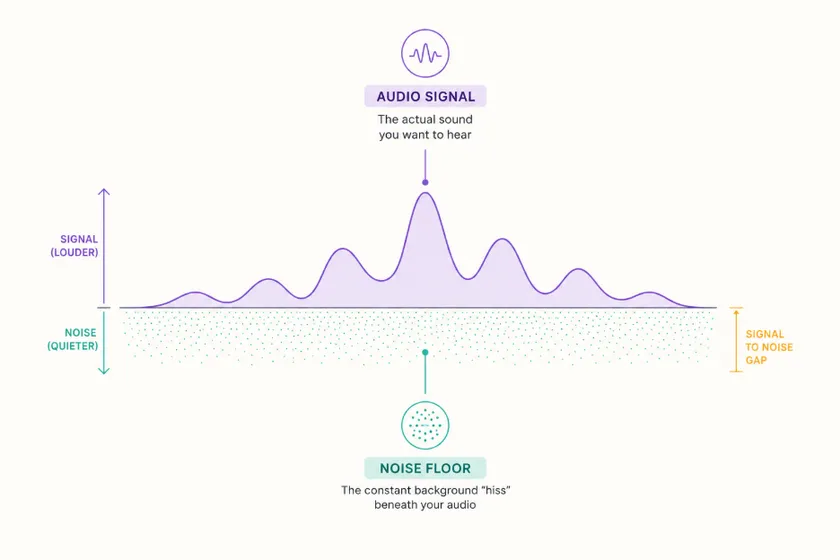
It’s measured two different ways depending on what you’re checking.
dBFS (decibels relative to full scale) is what your DAW meter shows. Digital zero is at the top. Everything else is negative. Your noise floor might read -60 dBFS in the DAW.
dB SPL (sound pressure level) is what a physical meter in the room shows. This is the actual acoustic noise level of your space. A treated studio hits 25-30 dB SPL. A bedroom hits 35-50 dB SPL.
Different scales for different things. The DAW meter tells you what’s making it to the recording. The SPL meter tells you what’s in the room.
The Bedroom Producer at -68 dBFS
A producer on the HomeRecording.com forum posted his setup measurements…”
He has a mid-range condenser, decent preamp, home computer, and his apartment room. His measured noise floor of -68 dBFS is neither impressive nor broken. It’s the honest reality of recording in a room where your computer is also running.
This is a common case that we have seen often.
The lesson → most bedroom producers are hitting somewhere between -55 and -68 dBFS at the track level, and that's normal.
Forum consensus across KVR Audio, Gearspace, and HomeRecording.com is remarkably consistent. -65 dBFS or lower is acceptable. Above -75 dBFS starts getting in the way of the material. -80 dBFS on the stereo bus with plugins running is what pros aim for.
If you’re checking your setup for the first time and seeing numbers in the -55 to -68 dBFS range, you’re not doing something wrong. You’re doing something normal.
The question isn’t whether the number is theoretically perfect. It’s whether the number matters for the material you’re making.
Our guide on headroom in audio covers the broader dBFS context if you want to understand where noise floor sits in the digital signal chain.
The Voiceover Artist Whose Noise Floor Doubled
An ACX-focused narrator posted on the Adobe community forum with a specific problem…Her baseline noise floor recorded clean at -60 dBFS. When she ran Match Loudness to meet ACX’s peak and RMS targets, her noise floor jumped to -40 dBFS. Denoising didn’t fix it. She was stuck.
This is one of the most misunderstood aspects of noise floor, and it’s worth naming plainly.
Every dB of gain you apply to a signal also raises the noise floor by exactly the same amount.
If your baseline is -60 dBFS and you add 20 dB of gain to hit a loudness target, your noise floor is now at -40 dBFS. The math is that simple. Normalization, compression, limiting, and any gain move in the chain brings the noise up along with the signal.
This changes what mastering can and can’t do. Loudness targets that seemed reasonable when the source was clean become punishing when the source has any noise floor to begin with. Aggressive limiting exposes noise the mix was hiding.
The fix isn’t at the mastering stage. It’s at the source. Our guide on mastering with a LUFS meter covers the loudness side. But the practical rule is: you can’t gain up a track without gaining up its noise floor. Every mastering decision downstream is limited by what the source can carry.
The Metal Producer Whose Noise Floor Didn’t Matter
A producer on the Gearspace forum was working on his first album…with a heavy modern rock mix, piling on plugins, and getting worried about accumulated plugin noise. He asked what noise floor was acceptable for a loud modern rock/metal mix. The pro consensus in the thread came back: -80 dBFS or lower on the stereo bus with all plugins active.
But here’s what the thread also revealed, mostly through what didn’t get said. His mix was already dense. Distorted guitars, layered drums, low-end weight, aggressive limiting.
A -80 dBFS noise floor is inaudible under that material. So is -70 dBFS. So, honestly, is -60 dBFS in most practical listening.
The lesson is one nobody in your reference set commits to: noise floor concern must be matched to the material.
- Dense productions (EDM, metal, dense pop, hip-hop): noise floor rarely audible, low priority
- Modern rock and pop: moderate concern, but rarely the deciding factor
- Acoustic and singer-songwriter material: real concern in fade-outs and quiet passages
- Jazz, classical, ambient: high priority, noise floor is part of the recording aesthetic
If you’re making dense modern material and worrying about noise floor at -68 dBFS, you’re worrying about something your listeners will never hear. If you’re making acoustic material and letting noise floor slide at -55 dBFS, you’re creating a problem you’ll fight through mastering.
The Producer Whose Real Problem Was Something Else
Multiple forum threads on the Adobe community, AVS Forum, and others reveal the same pattern: producers post asking why their noise floor is high, and the real issue turns out to be something else. It’s a ground loop from mixing power supplies. Or a cheap USB interface with poor shielding. Or a condenser microphone with inherent self-noise the producer didn’t know about. Or a room with untreated flutter echo that’s picking up frequencies that read as noise on the meter.
Noise floor is often the symptom, not the disease.
The real culprits behind unusually high bedroom noise floors:
- The computer itself. DAW fans, GPU fans, power supply hum. Move the computer to another room if possible, or record when it’s off.
- HVAC and ventilation. Turn off during takes. Real fix, not optional.
- Cheap USB interfaces. Sound on Sound’s coverage of budget interfaces has covered this repeatedly. Cheap USB power delivery creates noise floor above what the mic and preamp would produce alone.
- Ground loops. Unplug and replug on the same electrical circuit. Test with everything on one circuit vs distributed.
- Room acoustic reflections. Untreated rooms create noise floor from the source signal reflecting off surfaces, not from equipment at all.
- Microphone self-noise. Condenser mics have inherent electrical noise. Cheaper mics have more. iZotope’s noise floor guide covers the technical side.
The lesson: before treating noise floor as your primary problem, check whether one of the above is the actual cause. Usually it is.
What Mastering Can and Can’t Fix
Modern AI mastering platforms include noise reduction as part of the processing chain. That noise reduction handles what mastering can genuinely address:
- Gentle broadband denoising on quieter passages
- Frequency-specific noise reduction (hum removal, hiss reduction)
- Dynamic control to prevent noise from becoming audible during softer sections
- Subtle EQ to reduce specific noise frequency ranges
What mastering can’t do:
- Remove noise blended into the same frequency range as the music
- Undo a bad recording
- Reverse the noise floor rise caused by loudness normalization
- Create character where the recording had none
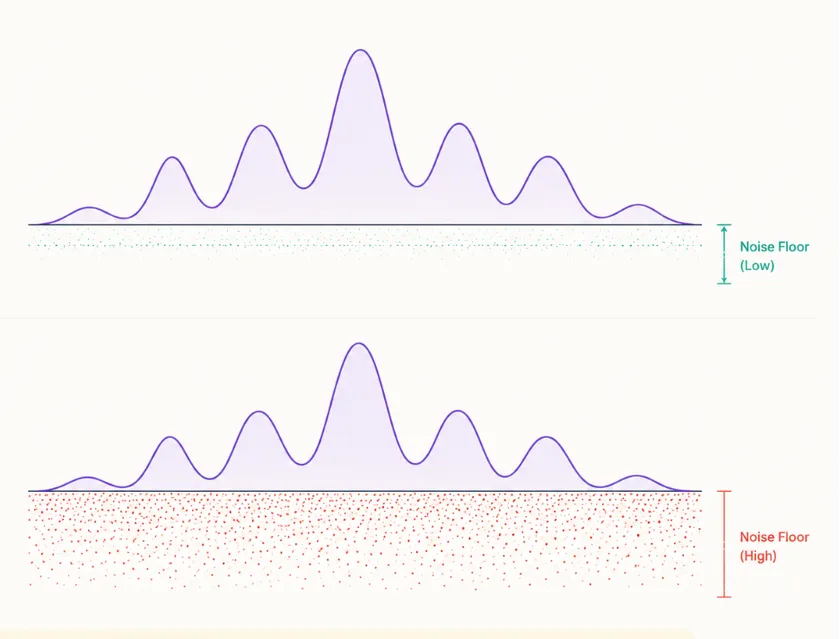
The core principle: the noise floor of your master is set by the noise floor of your source. Mastering polishes what’s there. It doesn’t rebuild what isn’t.
This is exactly where AI mastering tools earn their place in the workflow. A good AI mastering platform applies appropriate denoising as part of its processing without you needing to make the decision manually, but the source material still determines the ceiling of what’s possible.
What to Do About It
Practical framework based on the above four cases:
- Measure your noise floor first. Record silence for 30 seconds. Check the dBFS reading. If you’re in the -55 to -68 dBFS range, you’re in normal bedroom producer territory.
- Match your concern to the material. Dense productions rarely need better than -65 dBFS. Acoustic material benefits from -70 dBFS or lower.
- Fix the source before the mix. Every dB of noise you leave in becomes a dB of noise mastering has to work around.
- Address the real culprits. Computer noise, HVAC, cheap USB interfaces, and room reflections cause most bedroom noise floor problems. Not your gear.
- Trust mastering for the polish. AI mastering platforms handle appropriate noise reduction automatically. Don’t try to master a clean file after aggressive denoising in the DAW.
Summing all up
Noise floor is a fact of every recording setup, not a problem to solve at any cost.
The producers who obsess over it usually have bigger issues in their signal chain. The producers who ignore it entirely fight audible hiss at the mastering stage. The honest middle: know your number, aim for the target that fits your material, fix the actual sources of noise in your setup, and trust mastering to handle the polish.
Your noise floor doesn’t have to be studio-perfect to make releases that sound competitive. It has to be appropriate to the music you’re making.
Get genre-specific mastering choices
Remasterify applies genre-appropriate noise reduction as part of the AI mastering chain. Not a substitute for a clean recording, but a real polish stage that handles what mastering can genuinely fix. Upload your finished mix, hear the master in minutes.