
Can we guess your situation?
You’re a bedroom producer or an indie artist who wanna try releasing your first track.
And these questions might be bothering you right now!
- Do I need ISRC codes for my music to be released?
- Will I face trouble if I release without an ISRC?
- Is there a way I can get an ISRC for free?
Well, the list can go long and never-ending. So, you need a proper guide that can assist you in this chaos.
Here we are. In this post, we’ve detailed everything about ISRC codes. Most importantly, you’ll find a clear distinction between when you need an ISRC code and when you don’t.
TL;DR
- Every major distributor (DistroKid, TuneCore, CD Baby, LANDR) gives you a free ISRC when you upload it. Fully valid, recognized by every platform.
- You almost never need to buy an ISRC from a reseller. That’s paying for something your distributor gives you free.
- Self-register a $95 prefix at usisrc.org only if you run a label, release 15+ tracks per year, or need artist-owned codes for sync deals.
- The one ISRC mistake that costs real streams: re-uploading a track with a new code. Always bring your existing ISRCs to a new distributor.
- ISRC identifies the recording. UPC identifies the release. ISWC identifies the composition. Different codes for different layers.
Table of content
- What an ISRC Code Actually Is
- The Three Ways to Get an ISRC
- When You Genuinely Need to Self-Register
- When You Don’t Need to Buy or Self-Register ISRCs
- The One ISRC Mistake That Costs You Streams
- ISRC vs UPC vs ISWC
- What to Do Right Now
- IDRC Code FAQs
What an ISRC Code Actually Is
ISRC stands for International Standard Recording Code. It’s a 12-character permanent identifier for one specific sound recording. Governed by IFPI under ISO 3901.
It’s not the same as a UPC (which identifies your release as a product) or an ISWC (which identifies the composition). Different codes for different layers of the rights chain.
Here’s the point most articles bury:
An ISRC identifies the MASTER, not the song. A remaster gets a new ISRC. A remix gets a new ISRC. An acoustic version gets a new ISRC. The original vocal-only master and the fully-produced master are two different ISRCs, even though the song is technically the same.
Once assigned to a specific recording, an ISRC stays with that recording forever.
The Three Ways to Get an ISRC
Ranked by what actually makes sense for indie producers.
i. Through your distributor.
The right answer for 99% of producers. DistroKid, TuneCore, CD Baby, LANDR, Ditto, RouteNote, and every other major distributor assigns ISRCs automatically at upload. Free. Instant. Fully valid. Recognized by every streaming platform.
ii. Self-register a prefix with the US ISRC Agency.
One-time $95 fee at usisrc.org. Gives you your own registrant prefix, meaning every ISRC you generate is under your name or label rather than the distributor’s. Makes sense if you run a label or release a high volume of music across multiple distributors.
iii. Buy ISRCs from a reseller.
Per-code fees, usually $5-$20 per ISRC. Almost always a mistake. You’re paying for something your distributor gives you free.
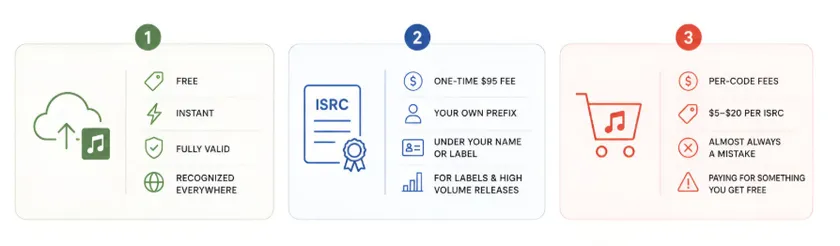
For the vast majority of independent producers, option one is the answer. Full stop.
When You Genuinely Need to Self-Register
Self-registering makes real sense in specific situations. Here are the ones where the $95 US ISRC Agency fee is genuinely worth it.
i. You run a record label.
You want every ISRC assigned to your label’s registrant prefix, not to a distributor’s. Consistency across your catalog matters when you’re building a label identity across dozens or hundreds of releases.
ii. You release music across multiple distributors.
Some tracks on DistroKid, some on TuneCore, some on CD Baby. Self-registered ISRCs stay yours regardless of which distributor handles which release. The prefix is consistent across your entire catalog.
iii. You release 15+ tracks per year.
The $95 one-time fee amortizes fast at volume. At 20 tracks a year, you’re at $4.75 per code within the first year. At 50 tracks, it’s under $2 each. Self-registration becomes cost-effective quickly.
iv. You have sync licensing or physical distribution deals.
Sync deals, film and TV placements, and physical distribution contracts sometimes require or strongly prefer artist-owned ISRCs. Self-registration removes friction from these deals.
v. You want long-term catalog control.
Self-registered ISRCs are yours forever. Distributor-assigned ISRCs remain attached to your recording permanently, but they’re registered under the distributor’s prefix. If catalog ownership matters to you at the identifier level, self-registration is the answer.
If any of these describe you, self-registering at usisrc.org is worth the one-time $95.
When You Don’t Need to Buy or Self-Register ISRCs
For most independent producers, you never need to buy an ISRC or self-register a prefix. Your distributor handles it. Free. Automatic. Fully valid.
Read this once first,
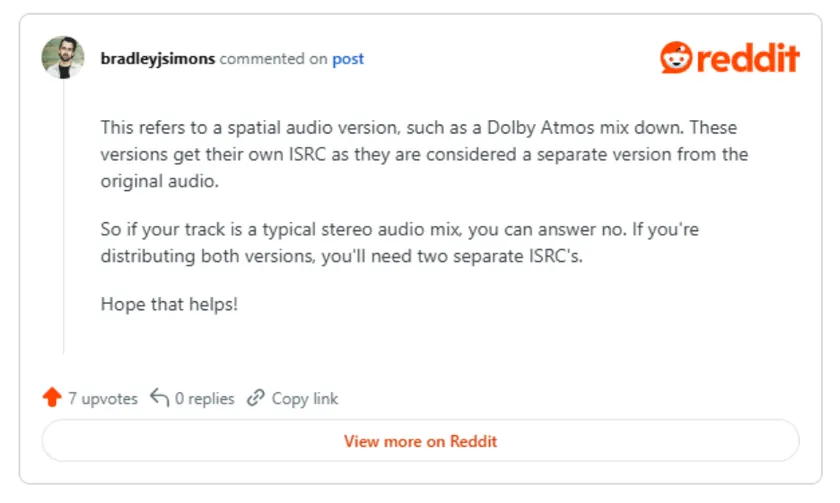
The question asked:
“When creating an ISRC code.
It asks a yes/no question, is this song immersive. What do they mean by, is it immersive?”
Here are the specific situations where you can completely ignore ISRC as a topic.
i. You’re releasing music through one major distributor.
DistroKid, TuneCore, CD Baby, LANDR, Ditto, RouteNote, Amuse, UnitedMasters, and every other major distributor auto-generates a valid ISRC for every track you upload. The code is registered under the distributor’s prefix but stays permanently attached to your recording. Streaming platforms treat it identically to any self-registered ISRC.
If you upload through one distributor and never move: your distributor’s ISRC is all you need. Ever.
ii. You’re releasing fewer than 15 tracks per year.
The $95 one-time fee for self-registration only makes financial sense at volume. At 15 tracks a year, you’re paying ~$6 per code for the privilege of registering under your own prefix. Below that volume, the math never works out. Distributor-generated codes save you money and time.
iii. You don’t run a record label.
Record labels self-register because they want every release under their catalog assigned to their prefix. Bedroom producers releasing under their own artist name have no such constraint. The distributor’s prefix on your ISRC is invisible to listeners and functionally equivalent to a self-registered code.
iv. You don’t plan to switch distributors frequently.
Distributor-assigned ISRCs can be brought to a new distributor when you switch (every major distributor accepts existing ISRCs during upload). The problem only arises if you fail to bring your ISRCs with you — and that problem exists regardless of who assigned them originally. Self-registration doesn’t protect you from your own upload mistakes.
v. You aren’t pursuing sync licensing or physical distribution.
Sync deals and physical distribution contracts sometimes prefer artist-owned ISRCs, but “prefer” isn’t “require.” If you’re not actively pursuing sync placements or pressing vinyl, this isn’t a real concern.
vi. You’re not selling ISRCs to other artists.
Some producers register their own prefix so they can charge other artists for ISRCs. If that’s not your business model, this doesn’t apply to you.
vii. You upload the same track under one release, not across multiple aliases or projects.
If you release under one artist name through one distributor, one ISRC per track is all you’ll ever need. Multi-project artists releasing the same recording under different aliases (which is rare and often violates distributor terms anyway) have edge-case ISRC concerns.
The One ISRC Mistake That Costs You Streams
Every ISRC-related concern above is minor compared to this one.
Re-uploading a track with a new ISRC destroys your stream history.
Every streaming platform tracks a recording by its ISRC. If you re-upload the same song with a different ISRC — either because you switched distributors and let the new one auto-generate, or because you deleted and re-uploaded on the same distributor — platforms treat it as a completely different recording.
The consequences:
- Your stream history resets to zero
- Playlist placements from the old ISRC don’t transfer
- Discover Weekly and Release Radar signals reset
- Chart eligibility restarts
The fix: when switching distributors, always bring your existing ISRCs with you. Every major distributor lets you input a pre-existing ISRC during upload. DistroKid, TuneCore, and CD Baby all support this. Use the field. Don’t let the new distributor generate a fresh code for a recording that already has one.
This is the mistake that actually matters. Not whether you self-register or accept the distributor’s code. Whether you preserve the ISRC across your career.
ISRC vs UPC vs ISWC
Quick disambiguation for readers confused by the three acronyms.
| Code | What it identifies | Who assigns it |
| ISRC | One specific sound recording | Distributor or self-registration |
| UPC | One release as a product (single, EP, album) | Distributor |
| ISWC | One composition (melody + lyrics) | Publisher or PRO |
The relationship: a song has one ISWC (the composition). That song can have multiple ISRCs (the studio version, the acoustic version, the remix). All those ISRCs can appear together on a release, which has one UPC.
Bedroom producers mostly interact with ISRC and UPC through their distributor. ISWC becomes relevant when you register with a Performance Rights Organization (PRO) like ASCAP, BMI, or your local equivalent.
What to Do Right Now
The practical action list based on your situation.
👉 If you’re releasing your first track:
Upload to your distributor. Accept the auto-generated ISRC. Save the ISRC for your records. Ignore anyone trying to sell you ISRCs.
👉 If you’re switching distributors:
Find your existing ISRCs in your current distributor’s dashboard. Enter them manually when uploading to the new distributor. Never let the new distributor auto-generate fresh codes for existing releases.
👉 If you’re running a label or releasing 15+ tracks per year:
Consider self-registering a prefix at usisrc.org. The $95 one-time fee gives you long-term catalog control and consistency across distributors.
👉 If you’re pursuing sync licensing or physical distribution:
Self-register. The upfront cost is trivial compared to the friction it removes from professional deals.
What option you have, let’s identify!
ISRCs are less complicated than most articles make them sound.
Your distributor handles it free for you unless you have a specific reason to do it yourself. The only mistake worth worrying about is losing your existing ISRCs when switching distributors. Everything else takes care of itself.
Don’t buy ISRCs from resellers. Don’t self-register unless you fit the specific situations above. Don’t overthink it.
Once your ISRC is sorted, mastering is the last stage before release.
Don’t worry about mastering.
We do it right.
Remasterify handles mastering stage automatically, so you can focus on getting the release right instead of worrying about codes.
IDRC Code FAQs
1. Do I need to buy an ISRC code?
No, almost never. Every major distributor including DistroKid, TuneCore, CD Baby, LANDR, and Ditto assigns a free ISRC to every track you upload. These codes are fully valid and recognized by every streaming platform. You only need to buy or self-register an ISRC if you run a record label, release 15 or more tracks per year, or have specific sync licensing needs.
2. How much does an ISRC code cost?
The US ISRC Agency charges a one-time fee of $95 to self-register a registrant prefix, which then lets you generate unlimited ISRCs under your own name or label. Buying individual ISRCs from resellers typically costs $5 to $20 per code. Getting an ISRC through your distributor costs nothing.
3. Where do I get an ISRC code?
Three options. Through your distributor (DistroKid, TuneCore, CD Baby, LANDR, and others assign free ISRCs at upload). Self-register a prefix at usisrc.org for a one-time $95 fee. Or buy individual codes from resellers, though this is almost always unnecessary. For most independent producers, the distributor option is the right answer.
4. What’s the difference between ISRC, UPC, and ISWC?
An ISRC identifies one specific sound recording. A UPC identifies a release as a product (the single, EP, or album that contains one or more recordings). An ISWC identifies the underlying composition (the melody and lyrics). A song has one ISWC, can have multiple ISRCs (studio, acoustic, remix versions), and all of those recordings can appear on one release with a single UPC.
5. What happens if I re-upload a track with a different ISRC?
Streaming platforms treat it as a completely different recording. Your stream history resets to zero, playlist placements from the old ISRC don’t transfer, Discover Weekly and Release Radar signals reset, and chart eligibility restarts. This is the single biggest ISRC mistake independent producers make when switching distributors. Always bring your existing ISRCs to your new distributor rather than accepting fresh auto-generated codes.