
I played a Miles Davis recording from 1959 at moderate volume.
Then I played a modern pop track in the same setting in parallel.
Do you agree that the difference isn’t just tone, production style, or era?
I felt that something in the shape of the sound is completely different.
The Miles Davis track feels like a room full of musicians breathing together. You can feel the room where it was recorded.
On the other hand, the pop track by DY Krazy feels like sound coming out of a speaker.
What you’re hearing is dynamic range. And more specifically, you’re hearing what happens when it’s preserved versus when it’s crushed.
Dynamic range is one of the most technical concepts in audio production, and also one of the most emotional. It’s the variable that separates music you feel from music you tolerate.
This blog is about what dynamic range is, why it disappeared from modern music, why it’s coming back, and how you can preserve it in your own work.
🗣️TL;DR
- Dynamic range is the difference between the loudest and quietest parts of a track. It’s what makes music feel alive instead of flat.
- There are two kinds: macro (verse to chorus) and micro (moment to moment). Both matter; both get crushed the same way.
- The loudness war of the 1990s and 2000s traded dynamic range for loudness. Metallica’s Death Magnetic became the cultural flashpoint.
- Streaming platforms normalize to LUFS, so crushed masters no longer win. Dynamic masters sound better on Spotify now.
- Preserve dynamics by leaving headroom, splitting the limiting into stages, and referencing dynamic modern releases, not just loudness targets.
Table of Contents
- What Dynamic Range Actually Is
- The Two Dynamic Ranges Nobody Distinguishes
- How Dynamic Range Disappeared: The Loudness War
- How Dynamic Range Varies by Genre
- Why Dynamic Range Makes Music Sound Alive
- How Streaming Changed Everything (Again)
- How to Preserve Dynamic Range in Your Own Music
- How to Measure Dynamic Range
- The Songs That Prove the Point
What Dynamic Range Actually Is
Dynamic range is the difference between the loudest peak and the quietest passage in a piece of audio, measured in decibels.
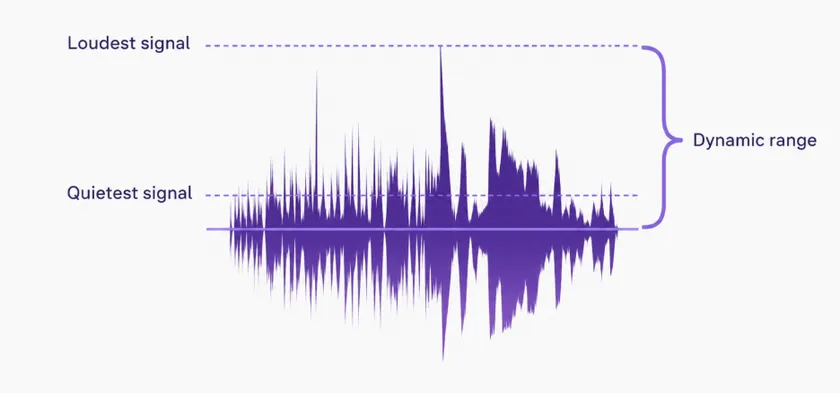
The concept applies at multiple levels:
- Human hearing covers roughly 90 dB, from a whisper (~30 dB) to a jet engine (~120 dB)
- CD-quality audio offers about 96 dB of theoretical dynamic range
- 24-bit digital audio offers a theoretical 144 dB, though playback systems can’t reproduce that
- Analog tape typically manages 60-70 dB
- Vinyl offers 55-70 dB depending on cutting technique
The dynamic range of recordings is shaped at three stages. It’s present in the source performance. It’s controlled during mixing. It’s finalized during mastering. Every stage can preserve it or crush it. Most modern music, until recently, chose to crush it.
Understanding dynamic range is the foundation for understanding almost every mastering decision that matters.
The Two Dynamic Ranges Nobody Distinguishes
Most articles you find about dynamic range treat it as one thing.
It’s actually two, and the distinction changes how you think about every mixing and mastering decision.
- Macro dynamic range is the level difference between sections of a song. Verse to chorus. Breakdown to drop. Quiet intro to full band entrance.
[This is the emotional architecture of the arrangement. When you feel a chorus hit harder than a verse, you’re feeling macro dynamics.]
- Micro dynamic range is the moment-to-moment variation within a passage. A snare hitting slightly harder than the previous one. A vocal phrase that swells and softens. The natural push and pull of a live performance. This is what makes music feel played rather than programmed.
Both matter.
Both get destroyed by aggressive compression, but they get destroyed differently. Macro dynamics die when the mix bus compressor is too aggressive across sections. Micro dynamics die when individual tracks are over-compressed before they ever reach the master.
When you say a mix sounds “flat” or “lifeless,” you’re usually reacting to lost micro dynamics. When we say a track “doesn’t build,” we’re reacting to lost macro dynamics.
How Dynamic Range Disappeared: The Loudness War
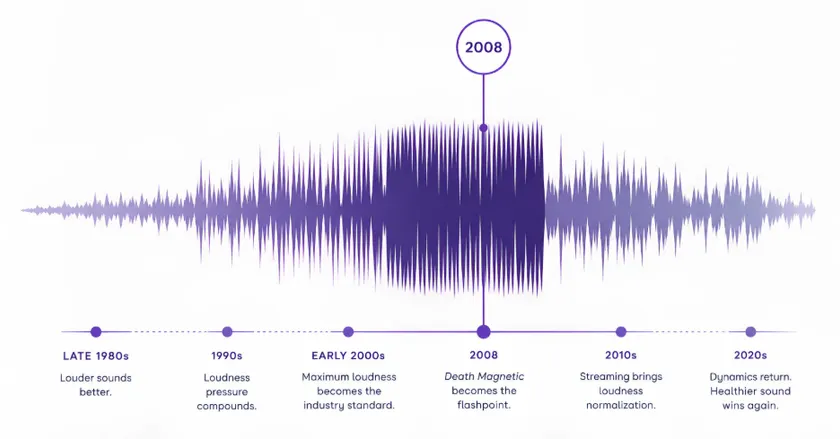
The loudness war started quietly in the late 1980s. As CD mastering became standard, engineers noticed that louder masters sounded better on radio and in jukeboxes. Loud grabbed attention. Loud won A/B comparisons.
Through the 1990s, this pressure compounded. Albums by Metallica, Oasis, and Red Hot Chili Peppers pushed loudness targets higher. By the early 2000s, mastering engineers were reporting industry pressure to deliver masters at unprecedented loudness, often at the cost of every ounce of dynamic range in the mix.
The cultural flashpoint arrived in 2008 with Metallica’s Death Magnetic.
The album was so heavily compressed that fans launched a petition asking for a remaster. The version released for Guitar Hero III was noticeably more dynamic than the retail CD, which produced the strange situation where the video game version sounded better than the actual album.
- Death Magnetic wasn’t the loudest master ever made. But it was the moment the industry noticed. Trade press covered it. Producers debated it. Consumers finally had a name for the frustration they’d felt for years.
The tide started turning in the 2010s.
Streaming platforms introduced loudness normalization, which meant crushed masters no longer won the loudness competition. By the 2020s, the professional consensus had reversed. Preserved dynamics were back in style, and modern releases are increasingly returning to healthier DR values.
The war didn’t quite end. It just stopped rewarding the winners.
How Dynamic Range Varies by Genre
Different genres use dynamic range differently. Some by tradition, some by necessity, some by aesthetic choice.
A 2016 study of dynamic range across musical styles published on NCBI provided some of the clearest data on this.
| Genre | Typical DR | What it means |
| EDM / Modern Pop | 4-8 dB | Densely produced, aggressive compression, built for clubs and phones |
| Rock / Hip-hop | 6-10 dB | Modern mastering conventions, moderate compression |
| Indie / Alt-Rock | 8-12 dB | More preserved dynamics, aesthetic choice |
| Jazz | 12-18 dB | Live performance dynamics preserved intentionally |
| Classical | 18-32 dB | Full symphonic dynamics from pianissimo to fortissimo |
| Live orchestra (unmastered) | 60-90 dB | The natural human perception range |
None of these numbers are wrong. They’re choices. An EDM track at 20 dB DR would feel underwhelming on a club sound system. A classical recording at 6 dB DR would lose the entire emotional arc of the composition.
The mistake modern music made wasn’t compressing pop to 6 dB DR. It was compressing rock, indie, and even singer-songwriter recordings to pop-level DR values, losing the character those genres depend on.
Why Dynamic Range Makes Music Sound Alive
Here’s the argument the technical articles you read so far never quite make.
Human perception of music is fundamentally comparative. For example, the chorus in a song doesn’t feel powerful because it’s loud in absolute terms. It feels powerful because it’s louder than the preceding verse. So, remove the difference, and you remove the experience’s impact.
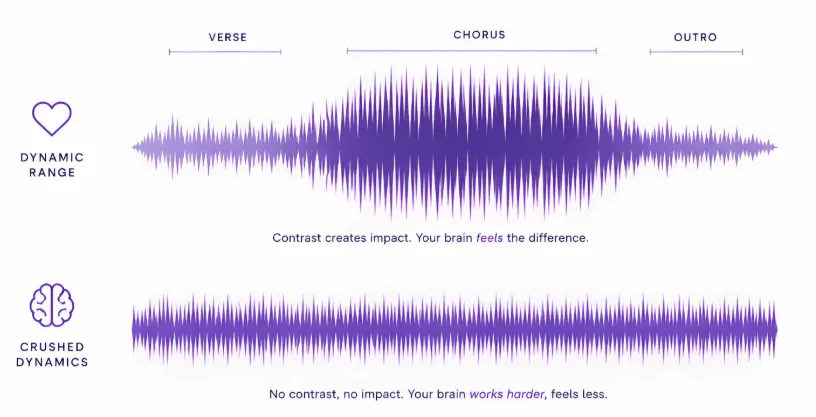
This is the same reason why crushed music causes listener fatigue.
Peer-reviewed research on compression perception has consistently found that listeners prefer more dynamic masters when volume is matched, even if they can’t articulate why. Their brains are working harder to find the emotional information the mastering flattened out.
Notice the phrases producers use for this — “punch,” “life,” “breathability,” “translation” — are all describing the same underlying phenomenon.
In short, music that preserves dynamic contrast feels alive because it lets your brain register the emotional architecture the artist encodes into the performance. Music that crushes dynamic contrast feels dead because that architecture is gone.
This isn’t sentimentality. It’s measurable perception. Two tracks at identical LUFS with different dynamic ranges will feel completely different to the same listener. The louder-averaging one won’t feel louder. It’ll feel smaller.
That’s the whole thesis of the modern return to preserved dynamics. Loudness stopped winning when the platforms stopped rewarding it. Dynamics started winning again because they always mattered.
How Streaming Changed Everything (Again)
Streaming normalization changed the math of mastering permanently.
Spotify normalizes tracks toward -14 LUFS integrated loudness. Apple Music targets -16 LUFS. YouTube Music targets -14. Tidal targets -14. Every major platform now measures your track’s loudness and adjusts it before the listener hears anything.
The consequence is counterintuitive. A track mastered at -14 LUFS with 12 dB of preserved dynamic range and a track mastered at -8 LUFS with 4 dB of crushed dynamic range will play back at roughly the same volume on Spotify. But the -14 version will sound better, because the platform turned the -8 version down without giving back any of the dynamic character it sacrificed to get loud.
This flipped the incentive completely. Before streaming, aggressive mastering won because loud beat dynamic on radio. On streaming, dynamic beats loud because the platform undoes the loudness advantage. Our guide on mastering with a LUFS meter covers the platform-by-platform breakdown.
The mastering engineers who understood this early started delivering more dynamic masters. The ones who didn’t kept fighting a war that was already over.
How to Preserve Dynamic Range in Your Own Music
Practical guidance for producers who want to master dynamic music without sounding weak on streaming.
👉 Leave headroom
Bounce your mix with peaks around -6 dBFS. No limiter on the master bus during mixing. Every extra dB of headroom is a dB of dynamic range you can choose to keep or use.
👉 Compress individual channels harder than the master
Aggressive compression on drums, bass, and vocals gets you consistency where you want it. Gentle compression on the master bus preserves the section-to-section dynamics your listener will feel.
👉 Split limiting across two stages
Soft-clip the transient peaks first, then use a brickwall limiter for the final ceiling. Doing all the limiting in one stage crushes both transients and macro dynamics simultaneously.
👉 Reference against dynamic modern releases
Not just against loudness targets. Match the dynamic character of professional releases in your genre, not just their LUFS number.
👉 Trust your ears at multiple volumes
Music that sounds punchy at high volume can sound weak at low volume. Music that translates across volume ranges is music with preserved dynamics.
Our guide to mastering dynamics (mastering dynamics post URL when live) covers the practical mastering-stage decisions in more depth. Our guide on headroom in audio covers the technical foundation.
How to Measure Dynamic Range
If you want to check your own work, three tools matter.
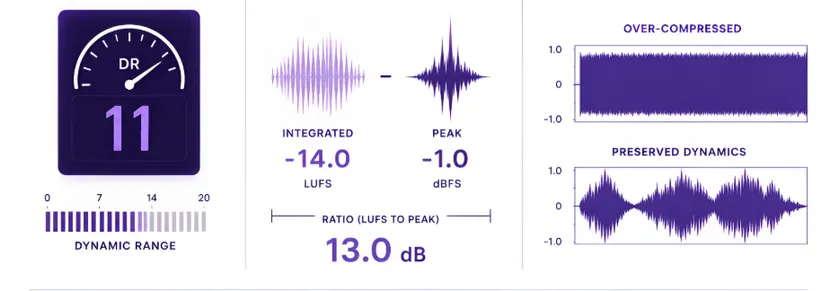
- DR meter (Pleasurize Music Foundation standard). Free tools available online. Measures the average crest factor across the entire track and outputs a single DR value. Higher numbers mean more preserved dynamics.
- LUFS-to-peak ratio. Compare your integrated LUFS reading to your peak dBFS reading. The larger the gap, the more dynamic range your master has.
- Waveform inspection. Bounce your master and zoom in on the waveform. If it looks like a solid rectangular block, dynamic range is nearly gone. If it looks like mountains and valleys, dynamics are preserved.
Target ranges vary by genre. Modern pop can sit at DR 6-8 and sound appropriate. Rock and indie usually feel best at DR 8-12. Acoustic and jazz recordings can safely go to DR 12-18 without feeling underpowered on streaming.
The Songs That Prove the Point
Concrete examples the reader can go listen to and hear the difference.
- Crushed, loudness-war era: Metallica, Death Magnetic (2008). Measured DR values in the 3-4 range. The Guitar Hero version of the same album at DR 8. Same songs, same performances, completely different feel.
- Modern release with preserved dynamics: Billie Eilish, When We All Fall Asleep, Where Do We Go? (2019). DR values in the 8-11 range. A modern pop record that hits emotionally because the quiet sections are actually quiet.
- Live performance dynamics: Miles Davis, Kind of Blue (1959). DR values above 15. Jazz recording that lets the room breathe. Play it and you understand what “alive” means in this context.
- Modern rock that hits both loud and alive: Tame Impala, Currents (2015). Careful mastering that preserves dynamics while staying competitive on streaming.
Listen to a track from each. Same volume setting. Feel the difference. That’s dynamic range doing its job.
Here’s the crux
Dynamic range is the emotional variable in music. It’s what separates a mix that feels alive from one that just measures loud. Modern music is starting to remember that, and the producers who understand it don’t have to choose between competitive loudness and emotional impact anymore.
The old rule was to make it as loud as possible. The new rule is to make it loud enough while keeping everything else intact. That’s what “loud and alive” actually means.
Remasterify is built for this shift. AI mastering that hits streaming targets while preserving the dynamic character of your mix. Upload your final stereo bounce, hear it mastered in minutes, and download it ready for release.