
Last year, fifteen of the top 100 Billboard artists decided not to release music in Dolby Atmos (while 85 did).
This gap spotlights the growing presence of spatial audio in 2026.
Major record labels are actively promoting it. And Apple Music pays artists about 10 percent more for each stream for Atmos tracks compared to standard stereo.
However, spatial audio is absent from the largest streaming service, unavailable on most consumer devices, and inaccessible to most listeners.
Which raises a fair question for anyone releasing music today. Is spatial audio worth the effort, or is stereo still the format that reaches people?
This article provides a clear overview of spatial audio, outlining what it is, its limitations, and why a well-mixed stereo track will continue to reach more listeners than a Dolby Atmos mix by 2026.
Summary
- Spatial audio is real and growing, but it’s still absent from Spotify and inaccessible on most consumer playback devices.
- The dominant format is Dolby Atmos, and Apple’s own policy explicitly bans upmixing stereo files into Atmos.
- Most listeners in 2026 still hear music in stereo through Bluetooth speakers, phone speakers, car stereos, and standard headphones.
- Spatial audio is worth pursuing for Logic Pro users, Apple Music-heavy catalogs, and signature releases — but stereo is still the practical choice for most indie artists.
What Is Spatial Audio?
Spatial audio is an audio playback method that creates the impression of sounds coming from all directions. This includes above and below, rather than just left and right.
Dolby Atmos, the most widely used format, is an object-based audio system used in cinemas for over a decade.
In June 2021, Apple Music introduced Spatial Audio with Dolby Atmos for music streaming, followed by Amazon Music Unlimited and Tidal.
Interestingly, Spotify did not adopt the format.
The term “spatial audio” is often used interchangeably with Dolby Atmos, though Apple’s Spatial Audio technically includes several technologies. In practice, most references to spatial audio in music mean Dolby Atmos.
Instead of assigning sounds to fixed channels like “left speaker” or “surround right,” Atmos treats each sound as an object placed anywhere in three-dimensional space around the listener.
How Spatial Audio Actually Works
The technical difference between stereo and Dolby Atmos is not only about having more channels; it involves a fundamentally different method of encoding audio.
A stereo file contains two channels; left and right.
Each sound is positioned by modifying its presence in each channel. This approach is simple, effective, and universally compatible.
A Dolby Atmos file stores each sound as a separate object with metadata denoting its position in three-dimensional space. During playback, the Atmos decoder reads this metadata and renders the sound in real time based on the playback system.
For example, a sound labeled “above and behind” plays through ceiling speakers in a home theater, while AirPods use binaural processing to simulate the same position.
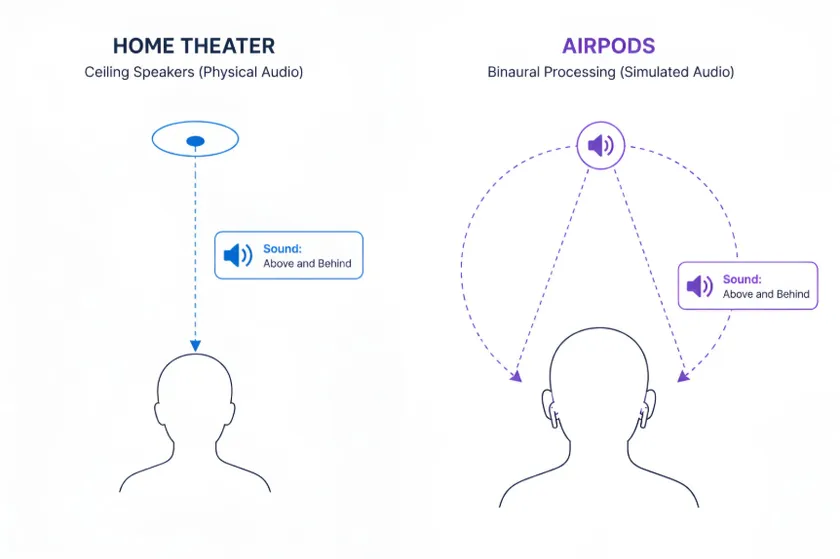
This is why the spatial audio experience on Apple Music changes significantly between AirPods Pro and phone speakers. The system adjusts object placement based on the available hardware, but phone speakers cannot deliver true spatial audio.
What Spatial Audio Isn’t
A great deal of marketing is being done around spatial audio, and some of it is misleading.
Here are three points that need clarification.
- Spatial audio is not an enhanced stereo system; it is a distinct format with unique production and playback requirements. Well-mastered stereo and Atmos recordings are separate products designed for different listening contexts.
- It is impossible to convert stereo sound to Atmos. According to Apple Music’s official policy regarding the delivery of Atmos content, it states clearly that “Dolby Atmos audio files produced from stereo mixes are not permitted. A Dolby Atmos track must be made from multitrack or from stems that have been created from multitrack. Conversion from a stereo release is not allowed.”
Mixing for Atmos differs from stereo
The Reason: Instead of two channels, engineers place individual sounds or groups (objects) into a three-dimensional soundfield using multitracks or stems. The typical workflow includes:
– Preparing the session with all individual instrument and vocal tracks available as separate stems
– Assigning each stem to a location in 3D space using the Atmos panning tools, not just left or right
– Balancing levels and movement to create an immersive effect, making decisions about what elements surround the listener, move above, or stay anchored in front
– Monitoring on both Atmos-enabled headphones and stereo to ensure the final mix still works when downmixed for stereo listeners
– Delivering both Atmos and standard stereo masters for distribution
This approach needs not only different tools but also a new mindset, as you are designing a true three-dimensional sonic experience rather than a traditional left-right stereo file. This distinction is important. Some AI mastering services claim to convert stereo to Atmos automatically, but Apple does not accept these files.
- It isn’t compatible with all devices. Spatial audio is not compatible with all devices. To use it, listeners need compatible headphones or speakers, an appropriate operating system, a supported streaming service, and the correct subscription level. If any link is missing, playback defaults to stereo. The section that most articles on spatial audio omit is the mathematical aspect of how people actually hear spatial audio.
Where Stereo Still Wins in 2026
Spotify does not support Dolby Atmos. Until January 2026, Spotify had not included Dolby Atmos or any spatial audio format. The service has hundreds of millions of active users, and all of them listen to stereo.
This one fact shows that most people who listen to music through streaming use stereo, even if they are not aware of it.
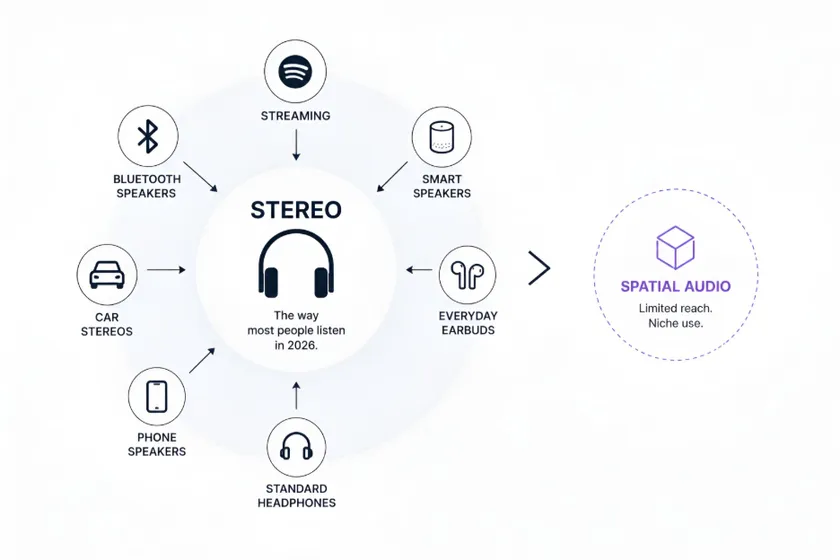
- Bluetooth speakers can’t play it. Bluetooth speakers cannot play spatial audio.
- Despite being the fastest-growing consumer audio category, they only provide stereo sound in all settings, including kitchens, showers, backyards, and parties. Phone speakers are the way most ordinary listeners take in music, particularly during the parts of the day when they are not concentrating on the music itself.
- Most car stereos are stereo systems. While Dolby is addressing this, only a limited number of car models will support Dolby Atmos by 2026. Most drivers will still hear music in stereo.
- Standard headphones, including most AirPods and non-premium earbuds, cannot produce binaural spatial audio. Most consumer headphones provide only stereo sound.
The math in this case is as follows: on Apple Music, where spatial audio is heavily promoted, most plays still occur via stereo fallback because listeners’ devices cannot decode the object-based format. Including Spotify, stereo remains the primary way most people will listen to music in 2026. In fact, it is important, but only in certain situations, not in all of them.
Spatial Audio Support
[Apple provides Logic Pro users with the full Atmos toolset without the need for a separate Atmos studio, giving Mac-based producers a real advantage.
But Logic Pro is not the only option. There are other digital audio workstations (DAWs) and tools that let you mix in Atmos.
For Windows users or those on a budget, affordable alternatives include Steinberg Nuendo and Reaper, both of which offer Atmos support with the right plugins.
Avid Pro Tools also supports Atmos, though it is a more advanced and pricier option. Dolby offers a free standalone Dolby Atmos Renderer that works with several DAWs and can help bring Atmos mixing to more producers without huge extra costs.
This means if your catalog has a strong presence of Apple Music content, then the royalty increase for Atmos delivery is real. Since your audience tends to consist of Apple Music users with AirPods Pro, the audience is available. ]
When Spatial Audio Is Worth Pursuing
Spatial audio is important, but only in some situations, not in all of them.
Since you are already using Logic Pro, Apple offers a complete range of Dolby Atmos tools, and therefore you won’t need a dedicated studio. You can export your music in ADM BWF format and send it to a distributor that supports Atmos, for example DistroKid, TuneCore, or most of the major aggregators. Be sure to include both the stereo master and the Atmos version, and make sure that they are the same length. Apple has clear instructions regarding metadata, stem alignment, and loudness targets. When submitting in Atmos, you must not exceed -18 LKFS and -1 dBTP. If you know Logic well, then carrying out this process is simple.
Spatial audio is most effective with genres that gain from having extra detail, such as jazz, classical, ambient, or cinematic music; in these cases, listeners tend to use headphones and give close attention. With radio pop or dance tracks, on the other hand, spatial audio is less important since people usually listen to them in cars, at parties, or on their phones.
For signature or audiophile versions of a release — such as a flagship album where the mastering is an integral part of the artistic identity—spatial audio is worth the effort. However, you shouldn’t apply it to every single or EP; instead, concentrate on the ones where it makes a real difference.
For listeners who use Apple Music, the 10 percent increase in royalties for Atmos is genuine. Since your fans frequently listen using AirPods Pro, they are part of an audience that can appreciate spatial audio.
For the majority of people who produce music for the indie scene in 2026, stereo recording remains the sensible choice since the learning curve for Atmos is very steep, the only available tools if you want to do it yourself are those in Logic Pro, and most of your listeners won’t be able to tell the difference.
What This Means for Indie Artists
Here’s the honest playbook for 2026.
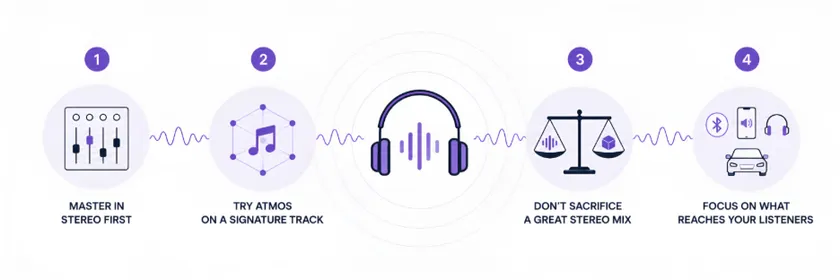
Master in stereo first. That version reaches most listeners, regardless of platform. Our guide on mastering your track in 5 steps explains the process, and our LUFS guide covers streaming loudness targets for your audience.
Try Atmos on a signature track, not every release. If you’re curious and use Logic Pro, pick a track that fits the format. Test the mix across devices. Use AirPods Pro to hear binaural rendering, standard headphones for stereo fallback, and your phone speaker to check everyday playback. Dolby’s free Atmos Renderer simulates different playback environments. If the mix holds up on all, it’s ready.
Don’t sacrifice a great stereo mix for a rushed Atmos one. A properly mastered stereo track that works across systems will always outperform a hurried Atmos mix that only sounds right on AirPods.
Focus on what reaches your listeners. In 2026, that still means stereo for most. Bluetooth speakers in kitchens, phone speakers on buses, standard headphones on commutes, car stereos on road trips. The physical infrastructure of everyday music listening is stereo and will be for years.
When to tackle it professionally
The honest move is to master your stereo release properly first. That version reaches every listener, on every platform, in every environment. If Atmos becomes the right call for a specific release later, you’ll have a strong stereo foundation to build from.
Remasterify handles the stereo mastering stage in minutes, at the loudness targets streaming platforms actually normalize toward, so your track lands ready on every system your listeners are already using.