
There’s a common assumption that dynamic EQ is always better than regular EQ. Most people tell us that it’s more flexible and precise- almost surgical- than a regular equalizer.
We have studied our competitors’ pages and other industry-led mastering platforms.
Here’s a thing we found:
Every modern plugin marketing page reinforces this idea, and every dynamic EQ tutorial you can find online tells you the same thing: use it more, use it everywhere, use it whenever you have a frequency problem.
BUT that’s not true.
Dynamic EQ is a real tool for specific problems. And it’s over-recommended by only that audio production ecosystem that benefits producers reaching it constantly.
So, this post you can count as an opener that will talk about what dynamic EQ actually does, when it genuinely wins, and when a static EQ or a different tool entirely would produce a cleaner result. Let’s dig in.
Table of Contents
- What Dynamic EQ Actually Is
- How Dynamic EQ Compares to Static EQ and Multiband Compression
- When Dynamic EQ Actually Wins
- When Static EQ Still Wins
- Common Dynamic EQ Mistakes
- Dynamic EQ at the Mastering Stage
- Practical Framework for the Decision
- Where That Leaves You
What Dynamic EQ Actually Is
Dynamic EQ is an equalizer that only engages when the audio signal at a specific frequency crosses a threshold you set.
A traditional (static) EQ boosts or cuts the frequencies you choose all the time, regardless of what the signal is doing. If you cut 3 kHz by 4 dB with a static EQ, that cut applies to every millisecond of the track, whether the 3 kHz frequency is prominent in that moment or not.
A dynamic EQ behaves differently. You still choose the frequency and the amount of cut or boost. But you also set a threshold. The EQ only engages when the signal at that frequency exceeds the threshold. When the signal is below the threshold, the EQ is inactive.
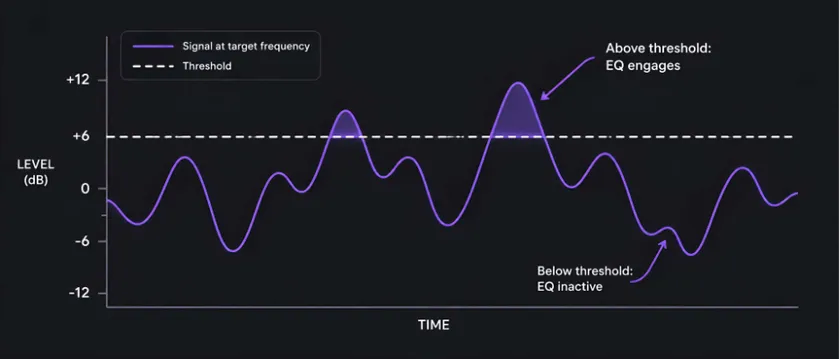
This makes dynamic EQ a hybrid tool. It has the frequency selectivity of a parametric EQ and the threshold-based behavior of a compressor. Every dynamic EQ band has the same core controls as static EQ (frequency, gain, Q) plus compression-style controls (threshold, attack, release).
If you want the broader EQ landscape, our guide on graphic EQ vs parametric EQ covers the two more common EQ types and where dynamic EQ fits as the third.
How Dynamic EQ Compares to Static EQ and Multiband Compression
Three tools address related problems in different ways. Understanding the distinction changes what you reach for.
| Tool | What it does | Best for |
| Static EQ | Constant boost or cut at chosen frequencies | Permanent tonal shape, corrective EQ |
| Dynamic EQ | Boost or cut only when frequency crosses threshold | Transient resonances, occasional problems |
| Multiband compression | Compress broader frequency bands based on level | Overall tonal balance, glue across frequency ranges |
The key difference between dynamic EQ and multiband compression is band width.
iZotope puts it well: dynamic EQ targets narrow parametric bands while leaving other frequencies untouched, whereas multiband compression compresses wider dedicated ranges.
For a snare that occasionally rings at 380 Hz, dynamic EQ. For controlling the overall low end of a mix, multiband compression. For a constant harshness at 3 kHz on a vocal, static EQ.
When Dynamic EQ Actually Wins
Four situations where dynamic EQ produces a better result than static EQ or compression.
- Transient-triggered resonances. A snare that rings out at a specific frequency only on the loudest hits. A vocal that gets sibilant only on certain consonants. A kick drum with a boxy midrange that only appears on the hardest strikes. Static EQ would cut those frequencies constantly, which dulls the sound during quieter moments. Dynamic EQ only engages when the problem appears.
- Competing frequencies between instruments. A bass guitar that clashes with the kick drum in a specific frequency range only when both play together. Dynamic EQ can duck the bass at that frequency whenever the kick hits, preserving the bass tone the rest of the time.
- Preserving natural dynamics while controlling problems. When you want to fix a specific frequency issue without flattening the entire dynamic range at that frequency. Static EQ removes character. Dynamic EQ removes only the problem.
- Vocal de-essing that responds to the vocal itself. A dynamic EQ tuned to sibilance frequencies (typically 5-10 kHz) acts as a de-esser that only engages on actual sibilance, not on the overall vocal presence.
When Static EQ Still Wins
This is the section every dynamic EQ tutorial skips. Static EQ isn’t outdated. It wins in specific situations that come up constantly in real mixing.
- When the problem is constant. A vocal that’s always harsh at 4 kHz doesn’t need a dynamic response. It needs a static cut. Adding a threshold and attack time to a permanent problem introduces complexity for no benefit.
- When you want tonal shape, not correction. If you’re carving space in a mix by cutting low-mid mud on rhythm guitars, that’s a shaping decision. It should apply constantly, not conditionally. Static EQ is the right tool.
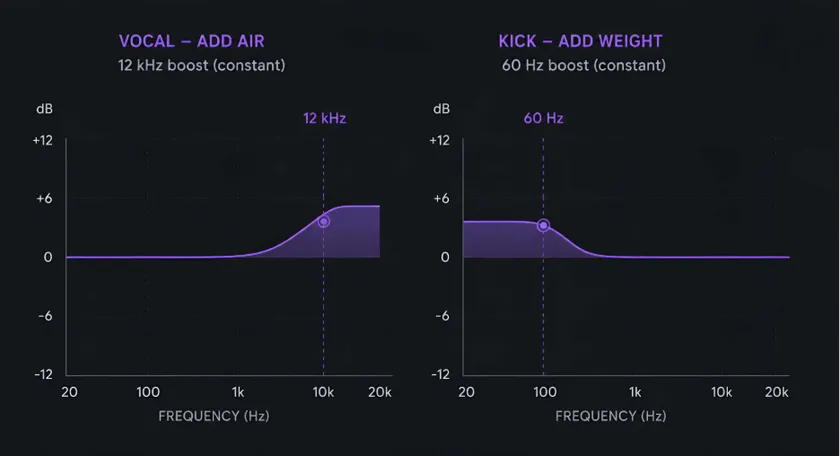
- When you want to shape the character of an instrument. Adding air to a vocal at 12 kHz should be constant. Adding weight to a kick at 60 Hz should be constant. These are creative tonal decisions, not problem-solving decisions.
- When the mix is already dynamic and controlled. If your source material has natural dynamic variation you want to preserve, adding a dynamic EQ can flatten what makes the mix feel alive. As one professional engineer put it, over-using dynamic EQ can “kill the original vibe of a piece of music, making it sound bland and formulaic.” The tool’s power is what makes it easy to overuse.
- When simplicity wins. Dynamic EQ has more parameters than static EQ. More parameters means more decisions and more places to make wrong ones. If a static EQ move works, a dynamic EQ move often doesn’t produce a meaningfully better result.
Common Dynamic EQ Mistakes
Three real mistakes producers make when they discover dynamic EQ.
→ Using dynamic EQ everywhere as an upgrade to static EQ
Dynamic EQ isn’t a better version of static EQ. It’s a different tool for different problems. Replacing all your static EQ moves with dynamic EQ adds complexity without adding benefit.
→ Setting thresholds too aggressively
When the threshold triggers on most of the signal, the dynamic EQ starts behaving like a static EQ but with added latency and CPU cost. The tool only earns its complexity when the threshold is set so it engages selectively.
→ Using dynamic EQ to fix a mix problem that belongs earlier in the chain
If a vocal is fundamentally too harsh, the vocal chain needs work. If a mix has muddy low-mids, that’s a mixing balance issue. Dynamic EQ can mask these problems but rarely fixes them. Our guide on why your mix sounds muddy covers where those problems actually get solved.
Dynamic EQ at the Mastering Stage
Dynamic EQ has a specific role at mastering that differs from its role in mixing.
At the mastering stage, dynamic EQ handles frequencies that misbehave inconsistently across a full track. A low-mid buildup that only happens in the chorus. A high-end harshness that only appears at loud playback levels. A resonance in a specific instrument that only shows up in isolated passages.
The mastering engineer’s version of dynamic EQ is usually gentler and more targeted than the mixing engineer’s. One to three dB of cut on a narrow band, triggered only when the problem appears. The goal is to keep the mix intact while addressing specific inconsistencies.
This is one of the many decisions AI mastering platforms handle automatically. When you upload a track, the system analyzes the frequency behavior across the entire duration and applies appropriate processing where needed. You don’t set thresholds. You don’t choose bands. The tool handles the analysis based on how the track actually behaves.
Our guide on how to master your track in 5 steps covers the broader mastering workflow, and our mastering dynamics guide covers the dynamics side of the decisions that get made at that stage.
Practical Framework for the Decision
The honest framework for choosing between dynamic EQ, static EQ, and other tools.
| The problem | Right tool |
| Constant tonal issue | Static EQ |
| Occasional resonance | Dynamic EQ |
| Broad frequency balance | Multiband compression |
| Sibilance in a vocal | Dynamic EQ or dedicated de-esser |
| Creative tonal shaping | Static EQ |
| Instruments clashing when both play | Dynamic EQ with sidechain |
| Dynamic problems across a full track | Compression, then dynamic EQ if needed |
The pattern: if the problem is inconsistent across the track, dynamic EQ probably wins. If the problem is consistent, static EQ probably wins. If the problem is broader than a specific frequency range, look at compression or multiband compression first.
Where That Leaves You
Dynamic EQ is a genuine tool for genuine problems. It’s not a replacement for static EQ. It’s not a shortcut to better mixes. It’s one option in a broader toolkit, and reaching for it because it feels sophisticated rather than because the problem calls for it is one of the most common mistakes in modern audio production.
The producers who use dynamic EQ well are the ones who reach for it only when the problem is inconsistent. Everyone else gets more mileage from a well-placed static EQ move and cleaner mixing decisions upstream.
→ At the mastering stage, tools like Remasterify handle these decisions automatically by analyzing your full mix and applying the right processing where the track needs it. If your mix is already dynamically controlled and tonally balanced, the mastering process becomes a light touch rather than heavy correction.