
We know there’s a specific frustration that every producer feels when mastering dynamics. And it looks like this 👇
You finish a master. On paper, it looks right. LUFS reading in the target range. Peaks controlled. No clipping. But when you play it back, something feels wrong. The chorus doesn’t hit harder than the verse. The drums feel weightless.
Ultimately, the mix sounds loud but tiny, like all the emotion got squeezed out somewhere between the last mixing decision and the final export.
That squeeze has a name. It’s the mastering stage crushing dynamics.
This post is about the difference between a master that reads well on a meter and one that actually moves a listener. Same track, same mix, wildly different emotional weight, all because of what happens to dynamics in the last stage of production.
✨ Summary
- Mastering to hit LUFS targets isn’t the same as mastering to preserve the life in your mix.
- Dynamics live at three levels: macro (verse to chorus), micro (moment to moment), and crest factor (peak vs average).
- Compression at mastering should feel invisible — 1 to 3 dB gain reduction, gentle ratios, slow attack.
- The limiter is where most damage happens. If you need more than 3 dB reduction, the problem is upstream.
- Match dynamics to the genre. Pop tolerates density. Rock preserves transients. Jazz needs room to breathe.
Why “Losing the Life” Is the Real Problem
Every producer who has released music has faced this. You master to competitive loudness, hit the streaming targets, and end up with something that measures perfectly but sounds flat.
The old loudness war framing said the answer was to just push louder. Compress harder. Limit harder. Get to -8 LUFS and win the perceived-loudness game. That thinking made sense in a pre-streaming era when everyone was competing on radio and CD playback.
It doesn’t work anymore.
Streaming platforms normalize to LUFS, not to peak. A track mastered at -14 LUFS with rich dynamics sounds more impressive on Spotify than the same track crushed to -8 LUFS, because the platform turns the loud one down and only the crushed processing remains. The dynamic version wins.
MusicRadar’s interview with professional mastering engineers put it clearly: loudness comes at the expense of dynamic range. The engineers they spoke with all agreed that pushing too hard sacrifices essential peaks for the benefit of quieter sounds, compromising sonic integrity to hit a loudness number.
That means the real skill in modern mastering isn’t hitting loudness targets. It’s hitting them without losing what makes the track feel alive.
🙄 What is mastering dynamics?
Mastering dynamics is the practice of controlling the volume relationship between the loudest and quietest parts of a track at the mastering stage, using compression and limiting to shape emotional impact without crushing the mix.
What Dynamics Actually Are (There Are Three)
Most conversations about dynamics blur three distinct things. Getting them straight changes how you master.
- Macro dynamics are the level differences between sections. The volume gap between a verse and a chorus. The drop after a breakdown. The buildup that pays off with impact. These are the emotional architecture of the track.
- Micro dynamics are the moment-to-moment variations within a passage. A snare hitting harder than a hi-hat. A vocal phrase that swells and softens. The push and pull of a live performance. These are what make music feel human rather than mechanical.
- Crest factor is the technical ratio between peak level and average level in the audio. High crest factor means the track has room to breathe. Low crest factor means it has been compressed hard and the peaks are close to the average.
All three matter. The technical process of dynamic range compression affects all three at once, whether you intend it to or not, and includes both downward compression (reducing loud sounds) and upward compression (raising quiet ones). Understanding which type you’re applying and which dynamic level you’re affecting is the difference between careful mastering and blind processing.
The Dynamic Range Target for Modern Masters
Numbers help. Here are the working targets for a well-mastered track that preserves dynamics while remaining competitive.
Integrated LUFS
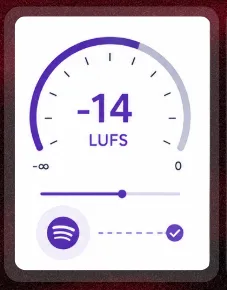
-14 LUFS for streaming. This matches Spotify’s normalization target, which means the platform doesn’t turn your track down. A -14 master with preserved dynamics sounds more impressive than a -8 master crushed to fit.
Dynamic Range (DR)
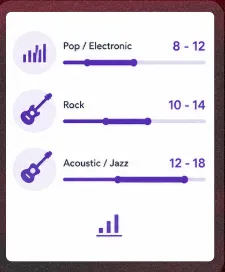
8 to 12 for pop and electronic. 10 to 14 for rock. 12 to 18 for acoustic and jazz. These come from professional mastering practice, verifiable through DR meter tools.
True peak ceiling
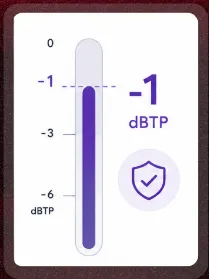
-1 dBTP for streaming safety. Lossy codec conversion can push peaks slightly above your master’s true peak reading, so leaving that dB of headroom protects against clipping.
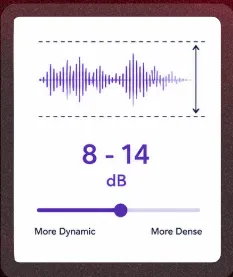
Crest factor
8 to 14 dB depending on genre. Higher for acoustic music. Lower for dense electronic productions.
Our complete guide on mastering with a LUFS meter covers the loudness numbers in more depth. The key point here is that hitting these targets by preserving dynamics is a different skill from hitting them by crushing everything into submission.
How Compression Shapes Dynamics at Mastering
The compressor is where most damage happens to dynamics. Understanding what each parameter actually does is the difference between glue and destruction.
Ratio
Low ratios (1.5:1 to 2:1) preserve micro-dynamics while gluing the mix. Higher ratios (4:1 and above) start crushing character. At the mastering stage, gentle is almost always right.
Attack
Fast attack (0.5 to 3 ms) catches transients but flattens the punch of every drum hit. Slow attack (10 to 30 ms) lets the transient through before compression engages, preserving the initial snap. For most rock, pop, and electronic music, slow attack is the honest choice.
Release
Fast release (30 to 80 ms) can cause audible pumping when the compressor snaps back between hits. Slow release (100 to 300 ms) breathes with the music. Auto-release on modern compressors handles this well if you’re unsure.
Threshold
Set it high enough that only peaks trigger the compressor. Aim for 1 to 3 dB of gain reduction at the loudest moments. If you’re doing 6 dB of reduction at mastering, back off. Something upstream needs fixing.
Interestingly, a 2014 peer-reviewed study published by the Audio Engineering Society found that listeners are less sensitive to dynamic range compression than commonly believed. The research showed that thoughtful compression, applied with care to the right elements, often has little perceptual downside beyond increased perceived loudness. The problem isn’t compression itself. It’s aggressive compression that crushes character.
The principle: at the mastering stage, compression should feel invisible. If a listener can hear the compressor working, it’s doing too much.
The Limiter: Where Most Masters Go Wrong
If the compressor is where damage begins, the limiter is where damage becomes permanent.
The limiter is the last processor in the mastering chain. It exists to catch peaks and enforce the final ceiling. When used correctly, it does that job invisibly. When used aggressively, it destroys everything a well-mixed track offered.
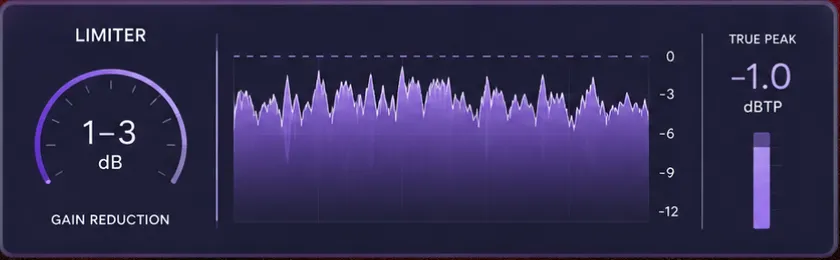
Practical guidance for a limiter that preserves the life in your mix:
- Place it last in the chain, after all other processing
- Aim for 1 to 3 dB of gain reduction on peaks, not 6 or 8
- If you need more reduction, the problem is upstream in the mix, not solvable at the limiter
- Set the true peak ceiling at -1 dBTP for streaming safety
- Fast attack with lookahead preserves transient punch
- Modern soft-knee limiters sound more natural than brickwall crushing
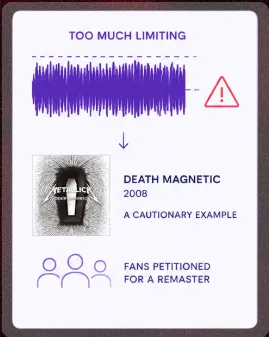
Metallica’s 2008 album Death Magnetic remains the cautionary example. The album was crushed so aggressively at mastering that fans launched a petition asking for a remaster. The masters that sound “loud but tiny” are almost always the ones where the limiter did too much work.
Our guide on headroom in audio covers the technical logic of leaving space in your master. That headroom is what lets the limiter work gently rather than aggressively.
Genre-Specific Dynamics Targets
Not every genre wants the same dynamic profile. Here’s what actually works across the biggest streaming genres.
🎤 Pop and electronic: -8 to -10 LUFS integrated, 6 to 10 DR. Aggressive compression is acceptable because the productions are already dense. Modern pop specifically expects density.
🤘 Rock: -9 to -11 LUFS integrated, 8 to 12 DR. Preserve drum transients. Rock dies when the snare stops snapping and the kick stops punching. Our full guide on mastering drum and bass covers the specific mechanics for bass-heavy electronic music.
🕺 Hip-hop: -8 to -10 LUFS integrated, 6 to 9 DR. Sub-bass control matters more than macro dynamic range. The kick and 808 relationship carries the track.
🎺 Acoustic, jazz, classical: -14 to -18 LUFS integrated, 12 to 18 DR. Minimal compression. These genres rely on natural dynamics as their entire aesthetic. Crushing a jazz recording to pop dynamics destroys its identity.
Match the target to the genre. A rock track mastered like a pop track sounds thin. A jazz track mastered like a rock track sounds fake.
When Your Master Sounds Flat
The troubleshooting section. Signs your dynamics are compromised at the mastering stage:
- The chorus doesn’t hit harder than the verse. Macro dynamics are crushed.
- Drums feel weightless despite adequate level. Micro dynamics are gone.
- The mix reads loud on meters but feels small on playback. Crest factor is too low.
- Extended listening causes fatigue faster than expected. Over-compression is exhausting the ear.
The fix is almost always upstream. Back off the master compressor. Reduce the limiter’s gain reduction. If the problem persists, the mix itself is too dense, and the master can’t compensate. Our guide on why mixes sound muddy covers many of the underlying mix issues that cause dynamic problems downstream.
The general principle: fix at the source, not at the master. A well-mastered track carries the character of the mix that fed it. It cannot invent character the mix didn’t have.
What This Actually Comes Down To
Mastering dynamics is not about protecting some abstract musical purity. It’s about the practical difference between a track that translates emotionally and one that reads as loud noise.
Every compression, saturation, and limiting decision at the mastering stage either preserves dynamics or trades them for something else. The producer who understands the trade builds masters that sound competitive on streaming without losing what made the mix worth mastering in the first place.
The old rule was “make it as loud as possible.” The new rule is “make it as loud as it needs to be while keeping everything else intact.” That’s the whole shift.
Remasterify is built for exactly this workflow. AI mastering that hits streaming targets while preserving the dynamic character of your mix. Upload your final stereo bounce, hear it mastered in minutes, and download it ready for release.